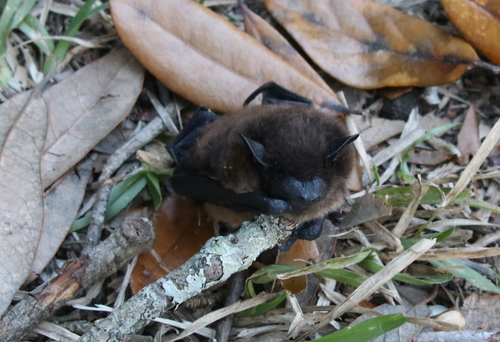
The North American Evening Bat is often one of the first to emerge to hunt each night, sometimes still in daylight, when most of its relatives wait for darkness to fall. It lives across much of the central and southeastern United States, with populations extending into eastern Mexico, and forms numerous breeding colonies in tree hollows, attics, and other structures. Its common name, North American Evening Bat, aptly describes its habit of emerging before the rest of the nocturnal bat community.
Small, with dark brown to reddish-brown fur, short, rounded ears, and a characteristic short, curved tragus (the small flap inside the ear). Easily confused with small Myotis bats and the Big Brown Bat (Eptesicus fuscus). It differs from the latter by its distinctly smaller size and a short, curved tragus instead of a straight, pointed one.
Peak energy frequency between 31 and 43 kHz, with frequency-modulated (FM) pulses forming a smooth curve, sometimes almost without inflection. On the detector screen, these appear as a rounded, descending sweep without marked breaks. Pulses last between 3 and 14 milliseconds during the search phase, shortening as the bat approaches prey.
Its frequency overlaps with several Myotis species and with Eptesicus fuscus from the same region. Therefore, reliable identification by sonogram requires comparing the curve shape and, whenever possible, having a capture or context. By sound alone, it is not always possible to separate the North American Evening Bat with complete certainty from these species.
Under its roosts (tree hollows, attics, eaves), small, granular guano accumulates that crumbles easily to the touch. The North American Evening Bat usually emerges to hunt shortly before or just at dusk, earlier than most bats with which it shares its habitat.
Open woodlands, crop edges and lowland urbanised areas, from the central and southeastern United States to eastern Mexico, generally below 1000 m altitude.
Flying insects, mainly beetles and moths, caught in flight over forest clearings, cultivated land, and areas near water.
It forms numerous breeding colonies, sometimes of several hundred females, in tree hollows and human structures during summer. It undertakes short migrations to warmer areas to spend the winter, without truly hibernating in the strict sense of other North American species.
The North American Evening Bat is considered abundant and its population stable throughout most of its range in the central and southeastern United States. However, it faces the same uncertainty as other North American bats due to the spread of white-nose syndrome.
Loss of trees with suitable cavities for breeding, and potential risk of White-nose Syndrome, a fungal disease affecting hibernating bats in North America.
See all species accounts for bats · Full species index
Mammaling is a free app for logging the mammals you find. You record a sighting in a moment — even if it's just a track — your life list grows, and the record becomes available to scientific and conservation projects.
It runs on your phone with nothing to install. If you like, it adds to your home screen like any other app.
Open Mammaling