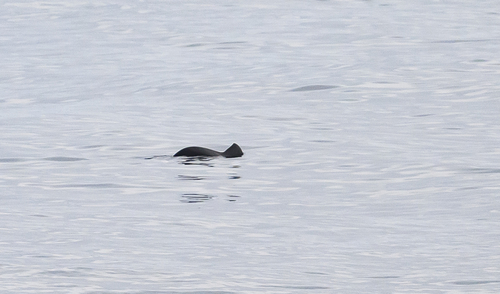
The Harbor Porpoise is the smallest cetacean in much of the temperate waters of the northern hemisphere. It is so discreet and elusive that it rarely approaches boats or leaps out of the water like dolphins, leading many people not to realise they share the coast with it. It has such a fast metabolism that it needs to feed almost continuously, day and night, as it can barely afford long periods of fasting without risking its energy reserves. Its common name in several languages alludes to the characteristic snort it produces when surfacing to breathe, a brief, strident sound that often betrays its presence before it is seen.
A small cetacean, the smallest odontocete in much of its range. It has a stocky body, dark grey on the back and lighter on the belly. Its head is small and rounded, without a distinct beak. The dorsal fin is low and triangular, very different from the falcate fin of dolphins.
It differs from the Common Bottlenose Dolphin and other coastal dolphins by its much smaller size, the absence of a beak, and its triangular dorsal fin instead of one curved backwards.
The Harbor Porpoise leaves no tracks on land. It is detected by a brief, discreet emergence of its back and small triangular fin, accompanied by a characteristic short, strident blow, audible at a distance in calm seas. Unlike dolphins, the Harbor Porpoise rarely leaps or approaches boats. Its presence often goes unnoticed, unless its repeated, regular emergence pattern, typical of its frequent breathing, is carefully observed.
Temperate and cold coastal waters, continental shelf and shallow estuaries of the Northern Hemisphere, generally avoiding warm tropical waters. It is found in the North Atlantic, North Pacific and inland seas such as the Baltic and Black Seas. Some subpopulations in these areas have a much more critical conservation status than the species globally.
It feeds on small schooling fish such as Herring and young Hake, as well as squid, caught through short, repeated dives throughout the day.
Generally solitary or in small, loosely cohesive groups, with discreet and elusive behaviour. Its accelerated metabolism requires it to feed frequently. Its more isolated populations, such as those in the Baltic Sea, show a genetic structure and conservation status very different from the more numerous oceanic populations.
The global population remains numerous and generally stable, though it varies greatly by region. The Baltic Sea subpopulation is in a much more critical situation, with very few breeding individuals, while the Black Sea subspecies also faces a greater threat than Atlantic populations.
Bycatch in fishing gear, especially gillnets, is the main cause of mortality for the Harbor Porpoise in much of its range. Other threats include pollution by persistent compounds that accumulate in coastal populations near industrialised areas, and underwater noise that interferes with its echolocation.
See all species accounts for even-toed ungulates · Full species index
Mammaling is a free app for logging the mammals you find. You record a sighting in a moment — even if it's just a track — your life list grows, and the record becomes available to scientific and conservation projects.
It runs on your phone with nothing to install. If you like, it adds to your home screen like any other app.
Open Mammaling