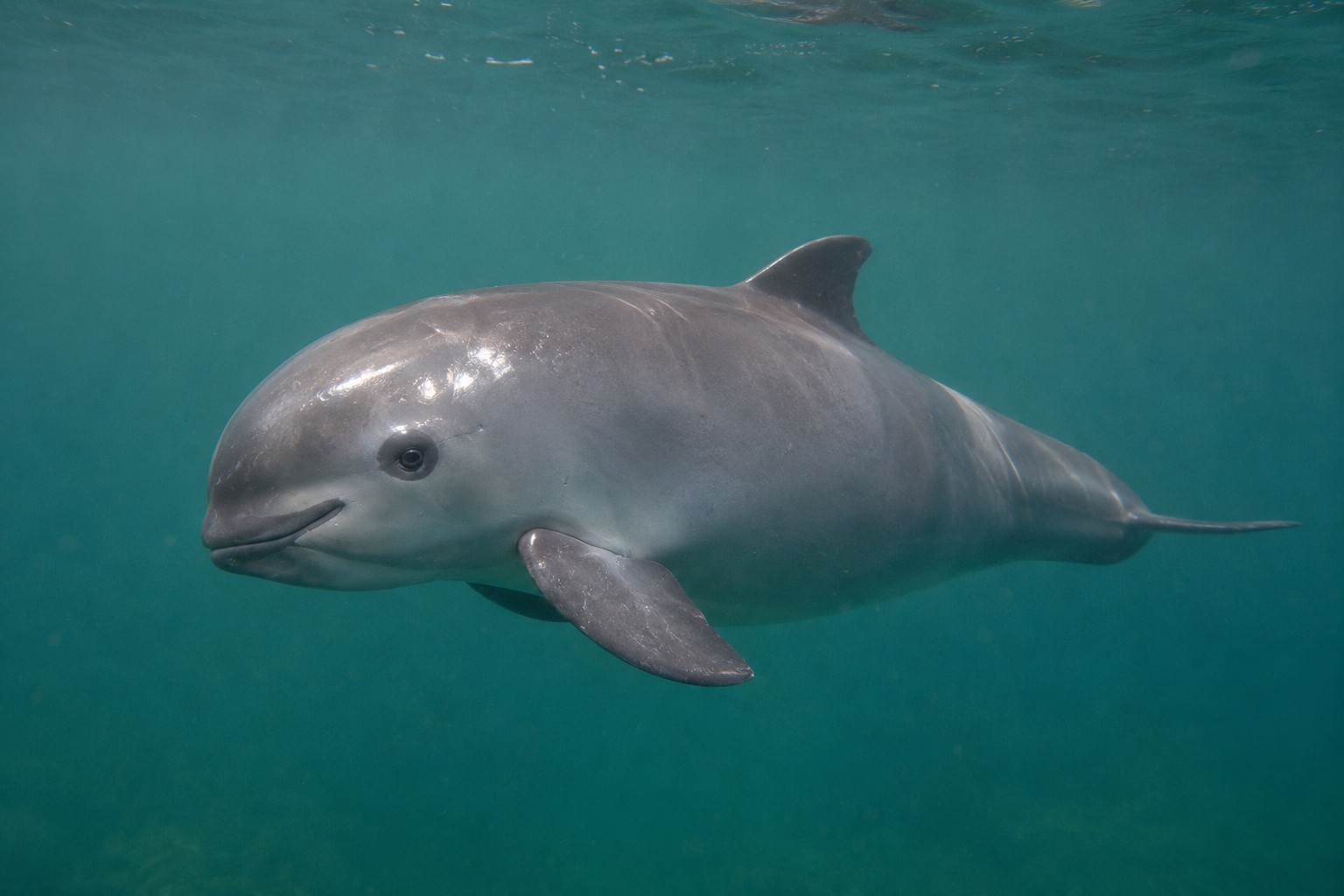
It is the smallest cetacean and almost certainly the most threatened in the world: the latest acoustic and visual surveys place its total population at fewer than ten individuals, all confined to a very specific corner of the northern Gulf of California. It is recognised by striking dark rings around its eyes and mouth, looking as though it were wearing a painted mask on a grey body that barely exceeds 1.5 m in length. Its decline is not caused by direct hunting or pollution, but by becoming entangled and drowning in gillnets set to illegally catch another fish sharing its waters, the Totoaba, whose swim bladder fetches extremely high prices in some Asian markets. Alongside the Javan Rhinoceros, it is one of the world's most frequently cited examples of a species facing extinction not through habitat loss, but through being caught as collateral damage in the illegal fishing of another species.
A tiny porpoise, the smallest of all the world's cetaceans, with a dark grey body on the back and paler belly, very visible dark rings around the eyes and dark patches on the lips giving a mask-like appearance. It is distinguished from any other cetacean in the Gulf of California by its diminutive size, small triangular dorsal fin, and exclusive restriction to that single basin; no other cetacean within its range can be confused with it.
It leaves no tracks and signs on land; it is detected at sea by a low, discreet blow that is barely visible, and by brief surfacing of the back with almost no splash, a behaviour far more secretive than that of other dolphins and porpoises. Elusive and avoiding boats, most current records for the species come from passive acoustic recordings of its high-frequency echolocation clicks, which can detect its presence even when not a single individual is seen on the surface. Occasionally, specimens are found stranded or drowned in illegal gillnets, the main documented source of mortality for the species.
Shallow, turbid waters of the extreme northern Gulf of California, usually at depths of less than 50 m. Endemic to this single basin in north-western Mexico, its home range has contracted drastically in recent decades, becoming concentrated in a tiny area known as the Vaquita Refuge.
It feeds on small fish and midwater and benthic squid, caught during short dives in the shallow waters of the northern Gulf of California.
Solitary or occurring in small groups of two or three individuals, highly elusive and difficult to observe, actively avoiding boats. Its reproductive behaviour is poorly known given the tiny size of the surviving population and the shy nature of the species.
Its population has plummeted by over 90% in little more than a decade, with the latest surveys estimating the total number of individuals at fewer than ten, despite the creation of a fishing exclusion zone and operations to remove illegal nets from its habitat.
Accidental entanglement and drowning in gillnets used for the illegal fishing of Totoaba, whose swim bladders are trafficked to Asian markets; this bycatch is by far the main and almost exclusive driver of its decline.
See all species accounts for even-toed ungulates · Full species index
Mammaling is a free app for logging the mammals you find. You record a sighting in a moment — even if it's just a track — your life list grows, and the record becomes available to scientific and conservation projects.
It runs on your phone with nothing to install. If you like, it adds to your home screen like any other app.
Open Mammaling