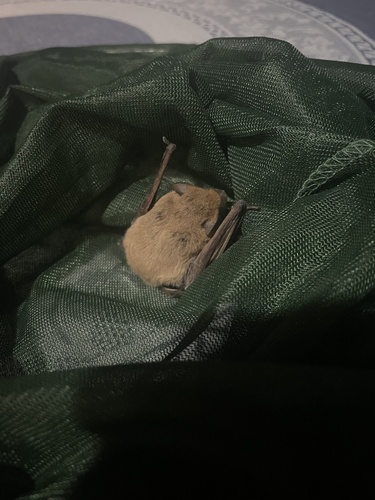
One of the bats that has best exploited the expansion of southern and central European cities, Kuhl's Pipistrelle is so well adapted to hunting around streetlamps and over urban parks that its populations have grown and expanded northwards across the continent in recent decades. Specialists link this expansion pattern to climate warming and the availability of roosts in modern buildings. It flies high and fast compared with other pipistrelles—a hunting style it shares with its relative of cliffs and crags, Hypsugo savii, with which it is very easily confused both by sight and by its echolocation call. It roosts in narrow crevices in buildings of all kinds, from apartment blocks to bridges, making it one of the easiest bats to encounter at dusk in any Mediterranean city.
A small bat, slightly larger than the Common Pipistrelle, with dark brown fur and a pale or whitish border along the wing membrane—a distinctive feature compared with other pipistrelles. It is easily confused with Hypsugo savii, which has very similar size and habits but lacks this light wing margin. Reliable identification between the two in the hand relies precisely on the presence or absence of this pale stripe along the wing edge.
Peak frequency between 35 and 39 kHz. FM-QCF type pulse: begins with a short steep sweep that flattens into an almost constant frequency section, visible on a bat detector as a stroke that starts sloped and levels out into a horizontal bar. Pulse duration 5 to 10 milliseconds, with an inter-pulse interval that shortens in hunting flight near an artificial light source. Extremely difficult to separate reliably from Hypsugo savii using a sonogram, as both species share a strongly overlapping frequency range; in areas where they coincide, reliable species identification often requires visual confirmation or capture. Below building crevices used as roosts, fine, granular guano accumulates in elongated piles, accompanied by urine staining on the adjacent wall. It emerges relatively early, shortly after sunset, and is frequently seen hunting in lingering daylight around freshly lit streetlamps.
Urban, suburban and open agricultural areas, roosting in crevices in buildings of all types, from lowlands to mid-mountain zones. Distributed across southern and central Europe, North Africa and parts of western Asia, with a well-documented northward expansion in Europe in recent decades.
Insectivorous, hunting small flying insects that frequently concentrate around streetlamps and other artificial light sources in urban areas.
Forms breeding colonies in building crevices, showing exceptional tolerance for heavily built-up environments. Its relatively high, fast flight for a pipistrelle, alongside its active exploitation of artificial lighting for foraging, largely account for its successful colonisation of new cities north of its historical range.
Populations are considered to be expanding across much of Europe, with an upward trend and colonisation of new areas towards the north of the continent, showing no signs of decline in any significant part of its range.
Building renovation and the sealing of crevices in modern structures, which can eliminate breeding roosts in specific areas, alongside insecticide use that locally reduces prey availability in urban environments.
See all species accounts for bats · Full species index
Mammaling is a free app for logging the mammals you find. You record a sighting in a moment — even if it's just a track — your life list grows, and the record becomes available to scientific and conservation projects.
It runs on your phone with nothing to install. If you like, it adds to your home screen like any other app.
Open Mammaling