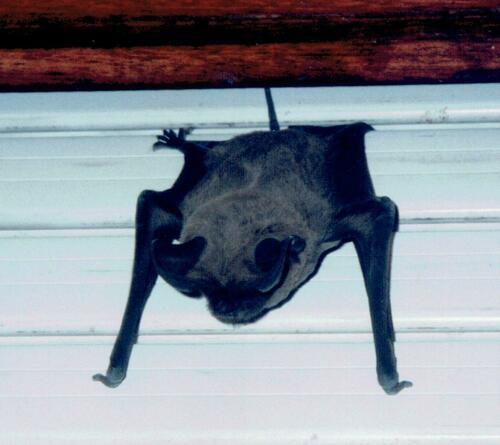
The European Free-tailed Bat is the largest bat in continental Europe. It is also one of the few whose lowest echolocation call can be heard by a person with good hearing, without the need for an ultrasound detector. This is a trait it shares with very few bats worldwide.
It flies very high and very fast, often several hundred metres above the ground. Its wingspan and speed are more reminiscent
The European Free-tailed Bat is a large bat, the largest in continental Europe. It has greyish-brown fur, large ears joined at the base, and a long tail that clearly projects free from the uropatagium. This feature gives the species its name and is not shared by any other European bat. Its characteristic combination of large size and free tail means it cannot be confused with any other species on the continent.
Peak energy frequency 11-14 kHz, the lowest of any common European bat, with pulses audible to the unaided ear of a young person in silent conditions. QCF pulses are visible on the detector as a very low and stable horizontal bar. Pulses are long, 15-25 milliseconds long, with a wide pulse interval typical of high-altitude flight in very open spaces. It is not acoustically confused with any other European species, thanks to its extremely low frequency. This is an unusual case of completely reliable acoustic identification among the continent's bats. Large, fibrous guano accumulates in piles under the wall below rock crevice roosts. The European Free-tailed Bat emerges relatively late after sunset, flying at high altitude from the outset. This makes direct observation difficult despite the ease of its acoustic detection.
Rocky cliff faces, coastal and mountain cliffs, and urban areas with tall buildings that mimic the structure of a rock face. The European Free-tailed Bat hunts in very open spaces at high altitude, from sea level to mid-mountain areas. Distributed across Southern Europe, North Africa, and parts of Western and Central Asia.
Insectivorous, it hunts medium-large flying insects at high altitude in very open spaces, with a fast, direct flight comparable to a swift's.
The European Free-tailed Bat forms breeding colonies in crevices of rocky outcrops and cliffs, tolerating tall buildings well in Mediterranean urban areas. Its high-altitude flight and its ability to cover long distances each night make it less dependent on linear landscape features than almost any other European bat.
Its populations are generally considered stable across most of its Mediterranean range, with no documented evidence of widespread decline.
Unregulated sport climbing on rocky cliffs used as breeding roosts, and occasional collision with elevated human structures during high-altitude flight.
See all species accounts for bats · Full species index
Mammaling is a free app for logging the mammals you find. You record a sighting in a moment — even if it's just a track — your life list grows, and the record becomes available to scientific and conservation projects.
It runs on your phone with nothing to install. If you like, it adds to your home screen like any other app.
Open Mammaling