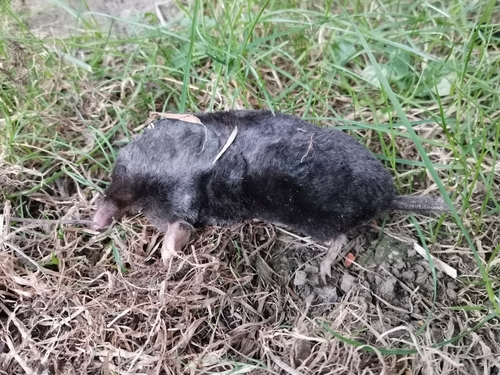
Described so recently that the Aquitanian Mole was only separated from the Common European Mole after genetic studies revealed differences so marked between populations in the southwest of the continent and the rest that they warranted species status. This pattern of taxonomic separation has recently been repeated in several groups of small mammals in the region.
It lives almost its entire life underground, excavating an extensive network of tunnels with its powerful, shovel-like fore feet. It only comes to the surface exceptionally, usually by accident or during juvenile dispersal.
Its name refers to the Aquitaine region in southwest France, although its actual range also extends across the north of the Iberian Peninsula.
The Aquitanian Mole is a small, cylindrical mammal highly adapted to subterranean life. It has very dense, velvety black fur, tiny, almost hidden eyes, no visible external ear pinna, and very broad, shovel-shaped fore feet with robust claws adapted for digging.
It is practically indistinguishable to the naked eye from the Common European Mole and the Iberian Mole, with which it shares part of its range. Reliable separation between the three species requires genetic analysis.
Due to its subterranean life, the Aquitanian Mole does not leave conventional tracks. The clearest sign of its presence are conical molehills, 15-25 cm in diameter, formed on the surface by earth expelled from deep tunnels.
Its superficial hunting tunnels also leave raised ridges of earth, visible as wavy lines under lawns or meadows. These are shallower than the large mounds from deep chambers. Droppings are rarely found on the surface, as they are deposited within the tunnel system itself.
Meadow, grassland, orchard, and forest with soft, deep soil suitable for excavation, from lowlands to mid-mountain areas.
Distributed across southwest France and the north of the Iberian Peninsula. Its distribution is still being refined following its recent taxonomic separation from the European Mole.
A subterranean carnivore, it feeds mainly on earthworms, supplemented by insect larvae and other soil invertebrates, caught within its network of tunnels.
Solitary and territorial, with an extensive system of underground tunnels that it defends from other individuals of its species.
It is active both day and night, in short cycles of activity and rest. It does not hibernate seasonally, needing to feed continuously due to its high metabolism.
The Aquitanian Mole maintains generally stable populations in most of its known range, with no documented signs of widespread decline.
The Aquitanian Mole faces no significant conservation threats across most of its range. Locally, it is subject to population control in some agricultural and garden areas due to the molehills it creates. It may also be affected by the use of poisons intended for other species.
See all species accounts for hedgehogs and shrews · Full species index
Mammaling is a free app for logging the mammals you find. You record a sighting in a moment — even if it's just a track — your life list grows, and the record becomes available to scientific and conservation projects.
It runs on your phone with nothing to install. If you like, it adds to your home screen like any other app.
Open Mammaling