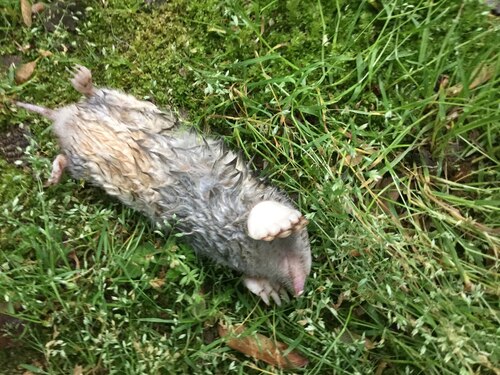
It spends almost its entire life underground, and its presence is noticed long before it is seen: it can excavate up to five and a half metres of tunnel in an hour using paddle-shaped front feet turned outwards, specialized for shoving soil aside with every stroke. Despite its common name, the Eastern Mole is not a particularly aquatic animal; the epithet "aquaticus" stems from a misunderstanding by the naturalist who described it, who mistook its webbed feet for an adaptation for swimming.
A cylindrical, velvety body 14-19 cm long, with no visible ears and tiny eyes hidden beneath the skin. The snout is pointed and pink, and the front feet, very broad and turned outwards like paddles, are unmistakable compared to any other mammal in its range. It differs from pocket gophers (Geomys, Thomomys), with which it shares habitat and also creates mounds, by lacking visible incisors outside the mouth and fur-lined cheek pouches for carrying food.
It leaves two very recognisable tracks and signs: sinuous ridges of raised soil running across the surface of lawns or fields, the result of very shallow foraging tunnels, and conical molehills of loose soil 15-30 cm in diameter at the ventilation points of deeper galleries. It differs from the fan-shaped mounds of pocket gophers, which are not linked by a continuous surface ridge, because those of the Eastern Mole do form a visible, continuous cord between molehills. It leaves no recognisable tracks, as it always travels underground.
Woodland, lawns, pasture and orchards with loose, well-drained soil, across the eastern and central United States and north-eastern Mexico.
It feeds mainly on earthworms and other soil invertebrates, with a smaller proportion of plant material.
Solitary except during the breeding season in early spring. It remains active underground year-round, alternating periods of activity and rest throughout the day and night.
A widely distributed species present in numerous protected areas, with no signs of a generalised decline; it is usually regarded as a garden and lawn pest rather than a species of conservation concern.
Pesticide use, which reduces the availability of earthworms and soil invertebrates, and direct pest control in urban and agricultural areas.
See all species accounts for hedgehogs and shrews · Full species index
Mammaling is a free app for logging the mammals you find. You record a sighting in a moment — even if it's just a track — your life list grows, and the record becomes available to scientific and conservation projects.
It runs on your phone with nothing to install. If you like, it adds to your home screen like any other app.
Open Mammaling