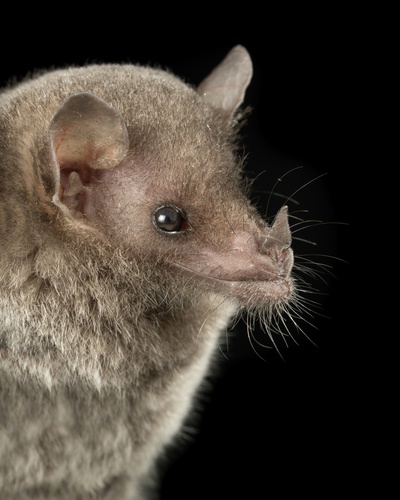
It has an extraordinarily long tongue in proportion to its body, with the covered tip of papillas that act almost like a brush capable of collecting nectar from very deep flowers to which no other pollinator can access, a trait that it shares with the rest of nectarivor mosquitoes of its group. It lives in the wet and mountain forests of the tropical Andes, where its role as a nocturnal pollinator is key to the reproduction of several plant species specialized in attracting mosquitoes instead of insects or birds. It was recognized as a distinct species after genetic studies separated several former forms included under the same name in the genre, an example of how the taxonomy of other Andes nectarivor mosquitoes continues in review.
Small-sized, very lengthy and narrow focico adapted to feed on nectar, extensible tongue much longer than the head, and practically absent tail.It differs from other nectar-rivory flies in its area by cranial and size details that in practice require capture for safe identification, since several species of the genus are extremely similar to each other in the field.
Mountainous and cloudy forest, generally between 1000 and 3000 m of altitude.Distributed by the tropical Andes of South America, mainly in Peru, Ecuador and Colombia.
Nectarivorus, feeds mainly on nectar and pollen of flowers specialized in pollination by deer, complemented with fruit and occasional insect.
Night activity, fly long distances between flowering patches following traditional feeding routes. You can enter a short daily lethargy to save energy, and form variable-size rest colonies in caves and tree holes.
Its populations are generally considered stable in most of its Andes area of distribution, although locally it depends on the conservation of the mountain forest and the plant species it pollinates.
Deforestation and fragmentation of the Andes mountain wetlands by agricultural and livestock expansion.
See all species accounts for bats · Full species index
Mammaling is a free app for logging the mammals you find. You record a sighting in a moment — even if it's just a track — your life list grows, and the record becomes available to scientific and conservation projects.
It runs on your phone with nothing to install. If you like, it adds to your home screen like any other app.
Open Mammaling