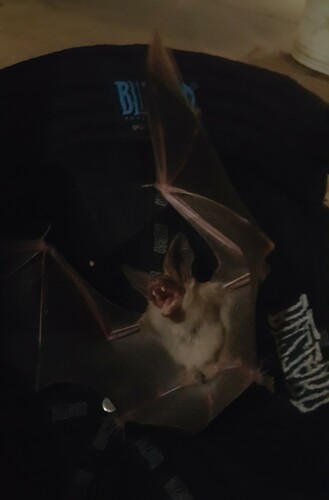
It hunts in a highly unusual way for a bat: instead of chasing flying insects, it flies low and slow over the ground, listening for the sound made by scorpions, centipedes and large beetles as they walk. It locates them by the sound of their own legs before pouncing and capturing them directly from the substrate. Tolerant to the sting of the scorpions it regularly hunts, it can withstand doses of venom that would be very painful for other mammals of its size. It inhabits arid and semi-arid regions of western North America, forming colonies in rock crevices, abandoned mines and human structures. Its name refers to the pale tone of its fur, one of the lightest colourings among North American bats. Unlike most bats that rely almost entirely on echolocation to hunt, the Common Pallid Bat uses echolocation mainly for orientation and obstacle avoidance, reserving the passive listening of prey sounds as its primary hunting tool.
A medium-large bat for a North American insectivore, with pale, cream to light brown fur, very large and widely separated ears, and a broad muzzle with visible glandular warts. It differs from other insectivorous bats within its range by its extremely pale fur and disproportionately large ears—a trait shared with few other bats in its region.
Peak frequency is between 60 and 30 kHz, featuring a very broad frequency-modulated (FM) downward sweep. On a detector screen, each pulse appears as a long, steep curve dropping from high to low pitch, quite distinct from the short, compact sweep of most bats its size. Pulses last between 2 and 5 milliseconds and are notable above all for their very low intensity; they are rarely detected at more than a few metres' distance, as this species hunts primarily by passively listening for prey noise and reserves echolocation for avoiding obstacles. It can be confused acoustically with the Big Brown Bat, whose downward sweep falls within a partially overlapping frequency range. However, the much lower intensity of the calls of the Common Pallid Bat and its low, slow flight near the ground usually distinguish it in the field. On poor-quality recordings, they cannot always be separated with certainty by the sonogram alone. Its colonies leave accumulations of guano beneath the roost in the form of elongated, brittle pellets that crumble easily to the touch, often mixed with partially digested scorpion and beetle exoskeleton remains. Emergences occur relatively late, well into the night after sunset. These tracks and signs confirm its presence.
Deserts, arid scrubland and rocky areas, from lowlands up to mid-altitude mountain slopes. Distributed across western North America, from south-western Canada to central Mexico.
Insectivorous, feeding mainly on large ground arthropods such as scorpions, centipedes, crickets and beetles, captured during low flight by passively listening to the noise they make while moving.
Forms colonies of variable size in rock crevices, abandoned mines and human structures, with individuals returning to the same feeding roost to consume larger prey. Nocturnal in activity, with a relatively late emergence after sunset, it does not undertake long migrations and generally remains near its roosts year-round.
Populations are generally considered stable across most of its range, although it is locally sensitive to disturbance at roost sites in abandoned mines and human structures.
Loss and sealing of roost sites in abandoned mines and human structures, along with pesticide use that reduces the availability of its terrestrial prey.
See all species accounts for bats · Full species index
Mammaling is a free app for logging the mammals you find. You record a sighting in a moment — even if it's just a track — your life list grows, and the record becomes available to scientific and conservation projects.
It runs on your phone with nothing to install. If you like, it adds to your home screen like any other app.
Open Mammaling