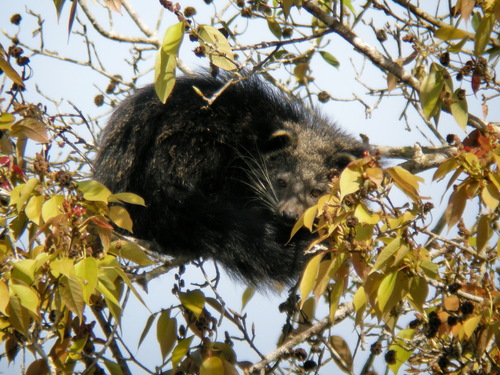
A large arboreal civet, popularly known as the “bearcat” for its shaggy, stocky appearance. Its urine, used to mark territory among the branches of trees, gives off a smell of freshly made popcorn.
Large for a viverrid, with a long, heavy body and short, sturdy legs, and thick, coarse black fur, sometimes mottled whitish. The tail is long, prehensile and bushy, thick at the base and tapering towards the tip, and is used like a fifth limb when climbing. Females are 20% larger than males.
Climbs with the help of its prehensile tail, leaving claw marks on tree bark. Its urine, used to mark territory on branches and trunks, gives off a characteristic sweetish smell like popcorn. Droppings contain abundant fruit seeds, as it is an important seed disperser.
Tall, dense forest of southern and south-eastern Asia, from India, Bangladesh, Bhutan and Nepal to Myanmar, Thailand, Malaysia, Laos, Cambodia, Vietnam, southern China, Sumatra, Kalimantan, Java and Palawan in the Philippines.
Omnivorous, with a marked preference for fruit, supplemented with small vertebrates, eggs and insects.
Mainly arboreal, it moves and rests among the branches thanks to its prehensile tail. Nocturnal and crepuscular; solitary or in small family groups.
Population declining by more than 30% since the mid-1980s, with populations increasingly small and fragmented across much of its original range.
Deforestation and logging for agriculture, and capture for the illegal wildlife trade.
See all species accounts for carnivores · Full species index
Mammaling is a free app for logging the mammals you find. You record a sighting in a moment — even if it's just a track — your life list grows, and the record becomes available to scientific and conservation projects.
It runs on your phone with nothing to install. If you like, it adds to your home screen like any other app.
Open Mammaling