Illustration generated with artificial intelligence from reference sources and reviewed by the team. Use it as a guide, not as a definitive identification key: it may contain errors in anatomical details such as the number of toes, claw marks or the scale. If something looks off, write to us at [email protected]: corrections from people who know the field are what keep improving these plates.
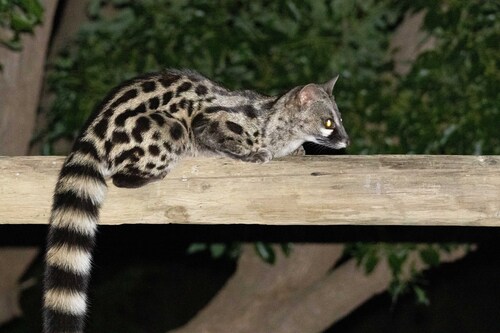
With its elongated body, dark spots, and long ringed tail, the Common Genet appears at first glance to be a cross between a cat and a mongoose, though it is not closely related to either. It belongs to its own group, the Viverridae, a lineage much older than that of the Felidae. It moves through branches with extraordinary feline agility thanks to a very flexible and semi-retractile body, capable of turning on itself in very narrow spaces. Although today it is considered part of the typical fauna of Southern Europe, the Common Genet is actually native to Africa. Its presence on the European continent is due to very old introductions, possibly as early as medieval times, linked to trade and its use as a domesticated rodent hunter.
A small carnivore with a very elongated body. It has yellowish-grey fur with rows of rounded dark spots. Its very long tail, almost as long as its body, has well-marked black and white rings and a white tip. It differs from the introduced domestic genet and other small European carnivores by its characteristic ringed tail. Another distinguishing feature is an erectile crest of hair along its back, which it can raise when threatened.
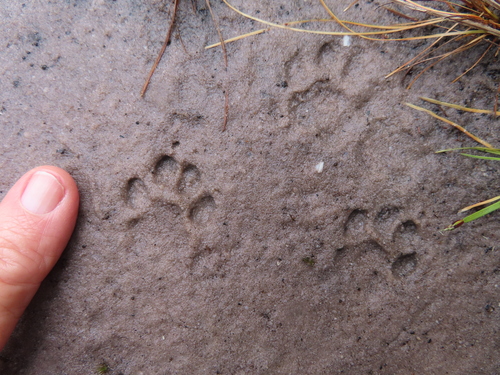
Small, elongated track, 2.5-3.5 cm long, with five toes and visible non-retractable claw marks, distinct from the rounded, clawless track of a cat. Cylindrical, twisted droppings, 6-10 cm long, are deposited repeatedly at the same spot, forming communal latrines on elevated rocks, fallen logs or crossroads. This marking behaviour is highly characteristic of the group. The Common Genet also marks with secretions from a perineal gland on rocky outcrops and low branches, leaving a persistent musky odour.
Mediterranean forest, scrubland, rocky areas and agroforestry mosaic areas. It shows good tolerance to human proximity in some regions, from lowlands to mid-mountain areas.
Native to much of Africa, the Common Genet was introduced centuries ago to the Iberian Peninsula and southern France, where it is now considered fully naturalised.
Opportunistic carnivore hunting small rodents, birds, large insects and reptiles, supplemented with fruit depending on seasonal availability.
Solitary and mainly nocturnal, with a large home range that it marks with communal latrines and glandular secretions. It is very agile at climbing and can shelter and rest in tree hollows or rock crevices during the day.
Its populations remain stable in most of its African and European range, with no signs of widespread decline, thanks to its ability to adapt to human-modified landscapes.
Roadkill, occasional persecution due to its perception as a predator of poultry in rural areas, and habitat loss of Mediterranean scrub in some regions.
See all species accounts for carnivores · Full species index
Mammaling is a free app for logging the mammals you find. You record a sighting in a moment — even if it's just a track — your life list grows, and the record becomes available to scientific and conservation projects.
It runs on your phone with nothing to install. If you like, it adds to your home screen like any other app.
Open Mammaling