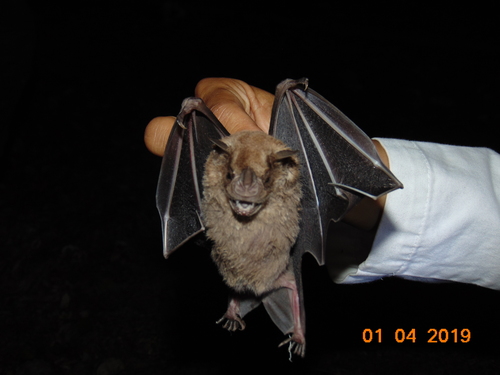
The Jamaican Fruit-eating Bat is one of the most effective seed dispersers in American tropical forests. It can carry fruits several times its own weight to a feeding perch away from the parent tree, hanging to devour them and dropping intact seeds that germinate clear of the original tree's shade and competition. It sometimes constructs temporary roosts by biting the veins of large palm or banana leaves until they fold into a tent shape, a behaviour shared with only a few other bat species globally. Females can delay embryonic development for several months after fertilisation, synchronising births with peak fruit availability even though mating occurs much earlier. It inhabits a wide variety of forest habitats in tropical and subtropical America, from rainforest to dry forest, and is one of the commonest, best-studied bats in the region.
A medium-sized bat with greyish-brown fur, a short muzzle with a prominent spear-shaped nose-leaf, no external tail, and often faint pale facial stripes. It is distinguished from other species of the same genus within its range mainly by its intermediate size and cranial details, as several congeneric species appear very similar in the field.
Tropical rainforest, tropical dry forest and transitional forest, from lowlands to mid-mountain elevations. Distributed across much of tropical and subtropical America, from northern Mexico to northern South America, including the West Indies.
Frugivorous, feeding mainly on figs and other tropical tree fruits, supplemented with nectar, pollen and the occasional insect.
Forms roosting colonies of variable size in caves, tree hollows and folded-leaf tents that it constructs by biting leaf veins. Females can delay embryonic development to synchronise birth with periods of peak fruit abundance, typically producing two litters a year across much of their range.
Populations are considered stable throughout most of its broad distribution, favoured by its high capacity to adapt to different forest habitat types.
Faces no significant threats at the species level; locally it suffers from deforestation and loss of roosts in areas heavily transformed by agriculture.
See all species accounts for bats · Full species index
Mammaling is a free app for logging the mammals you find. You record a sighting in a moment — even if it's just a track — your life list grows, and the record becomes available to scientific and conservation projects.
It runs on your phone with nothing to install. If you like, it adds to your home screen like any other app.
Open Mammaling