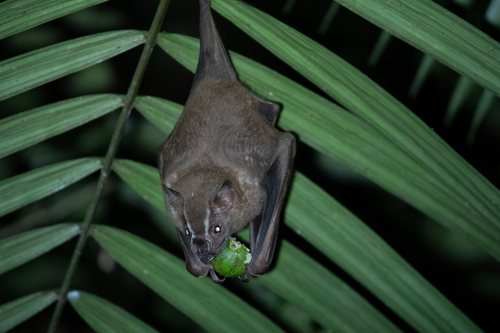
It is one of the largest and most robust fruitful frogs in tropical America, capable of transporting large-scale fruits to a feeding pond away from the mother tree, where it hangs down to devour them and let the seeds fall intact away from the shadow of the original tree. Its distribution spans much of tropical and subtropical America, from wet jungle to dry forest, and its role as a seed dispersor is key to the regeneration of numerous large fruit tree species that few other animals can transport. Its taxonomic situation includes several regional forms, some historically treated as subspecies and others sometimes elevated to the range of own species, a reflection of what results in the systematic use of neotropic fruitful frogs.
Large-size dwarf for an American frugivore, gray brown fur, short fox with nasal leaf in the shape of a lance well visible, two clear facial lines on each side of the face, and absence of external tail. It differs from other species of the genus Artibeus of its area mainly by its clearly larger size, being in fact the largest frugivore dwarf of much of its distribution.
Tropical rainforest, dry tropical rainforest and transitional rainforest, from low lands to middle mountain heights.Distributed across much of tropical and subtropical America, from the center of Mexico to northern Argentina.
Frugivorous, it feeds mainly on fig fruit and other tropical large fruit trees, complemented with leaf, nectar and occasional insect.
It forms variable-size rest colonies in large tree holes, caves and human structures, with night feeding flights that can go several kilometers away from the shelter in search of fruit trees.
Its populations are considered stable in most of its wide distribution area, favored by its great ability to adapt to different types of forest habitat.
It does not face significant species-level threats; locally it suffers deforestation and loss of large trees with holes available for shelter.
See all species accounts for bats · Full species index
Mammaling is a free app for logging the mammals you find. You record a sighting in a moment — even if it's just a track — your life list grows, and the record becomes available to scientific and conservation projects.
It runs on your phone with nothing to install. If you like, it adds to your home screen like any other app.
Open Mammaling