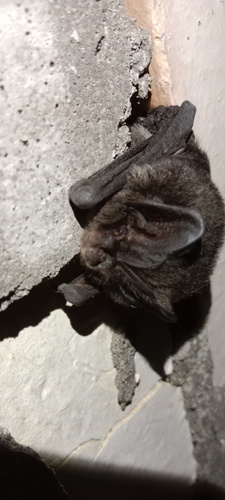
The Western Barbastelle has one of the most distinctive faces of all European bats, with wide ears joined at the base above the forehead and a short, flattened snout. This gives it an almost "squashed-face" appearance, very different from other species in its environment.
The Western Barbastelle is strongly associated with mature forests. It is so dependent on old trees with cracks and loose bark for shelter that its presence in an area is often considered a good indicator of that forest's quality and maturity.
It hunts almost exclusively moths, including many species that have developed the ability to detect and evade the echolocation of other bats. This is an evolutionary arms race between predator and prey, which the Western Barbastelle seems to win thanks to an especially quiet echolocation system.
A small to medium-sized Western Barbastelle, with very dark, almost black fur, the hair bases whitish giving a frosted effect. It has broad ears joined at the base above the forehead and a short, flattened muzzle. It is easily distinguished from other European bats by this joining of the ears above the forehead, a feature not shared by any other species in its range.
It leaves no identifiable terrestrial tracks and signs. The droppings are small and friable, 6-9 mm long, with moth chitin remains predominating over those of other insects, accumulated under cracks in loose bark or tree hollows used as roosts. At night, the Western Barbastelle emits low-intensity echolocation pulses, much quieter than those of other bats. This is an adaptation that allows it to approach moths capable of detecting the sonar of other species before they perceive its presence.
Mature woodland, especially deciduous, with abundant old trees providing cracks and loose bark for roosting. It also hunts over hedges and watercourses near the woodland.
Distributed throughout much of Europe and North Africa, from lowlands to mid-mountain areas.
A highly specialised insectivore, feeding on nocturnal moths which it hunts in flight near the forest canopy using low-intensity echolocation.
During summer, the Western Barbastelle forms female maternity colonies in tree hollows and bark crevices. It frequently changes roosts within the same forest.
In winter, it hibernates in caves, mines, or rock crevices with stable temperatures. It makes short seasonal movements between summer and winter roosts.
Its populations have suffered notable declines in several regions of Europe due to the loss of mature forest with old trees. However, it remains relatively widespread where forest stands of sufficient quality and age persist.
Loss of mature forest and old trees with crevices due to intensive forest management, use of pesticides reducing its moth prey, and disturbance in hibernation roosts in caves and mines.
See all species accounts for bats · Full species index
Mammaling is a free app for logging the mammals you find. You record a sighting in a moment — even if it's just a track — your life list grows, and the record becomes available to scientific and conservation projects.
It runs on your phone with nothing to install. If you like, it adds to your home screen like any other app.
Open Mammaling