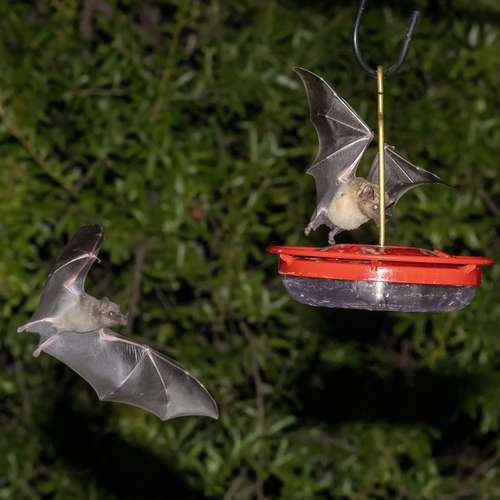
It has an extraordinarily elongated snout and tongue, adapted for plunging deep into tubular flowers to drink nectar. It shares this anatomical design with hummingbirds despite being entirely unrelated to them, making the Mexican Long-tongued Bat one of the most important pollinators of agaves and columnar cacti in the North American desert. It follows a seasonal migratory pattern known as the nectar corridor, moving northwards in spring and summer by following the sequential blooming of agaves, then retreating south again in autumn when flowers become scarce; a movement synchronised with the reproductive cycle of the plants on which it feeds. Its role as a pollinator is so vital that the production of certain agave varieties used traditionally depends in part on its presence.
A medium-sized bat with greyish-brown fur, a very long, narrow snout ending in a small noseleaf, and an extensible tongue much longer than its head, adapted for nectar-feeding. It differs from other nectar-feeding bats in the region by its particularly long, narrow snout and by lacking an externally visible tail, unlike some of its relatives.
Desert and xerophytic scrub with flowering agaves and columnar cacti, rocky canyons and transitional woodland, from lowlands up to mid-mountain areas. Distributed across the south-western United States, Mexico and parts of Central America, making seasonal migratory movements that track agave blooms.
Nectarivorous, feeding on nectar and pollen from agave flowers and columnar cacti, supplemented occasionally with soft fruit and insects depending on seasonal availability.
It undertakes seasonal migrations following the sequential blooming of agaves, moving northwards in spring and summer and retreating south in autumn. It forms nursery colonies in caves and rock crevices, and its role as a pollinator is key to the reproduction of numerous desert agave and columnar cactus species.
Its populations are considered to be in some decline, linked to the loss of flowering wild agaves through harvesting for spirits production and to the disturbance of cave roosts used during migration.
Loss of flowering wild agaves due to intensive harvesting for the spirits industry, disturbance at cave roosts used during seasonal migration, and loss of desert habitat to urban development.
See all species accounts for bats · Full species index
Mammaling is a free app for logging the mammals you find. You record a sighting in a moment — even if it's just a track — your life list grows, and the record becomes available to scientific and conservation projects.
It runs on your phone with nothing to install. If you like, it adds to your home screen like any other app.
Open Mammaling