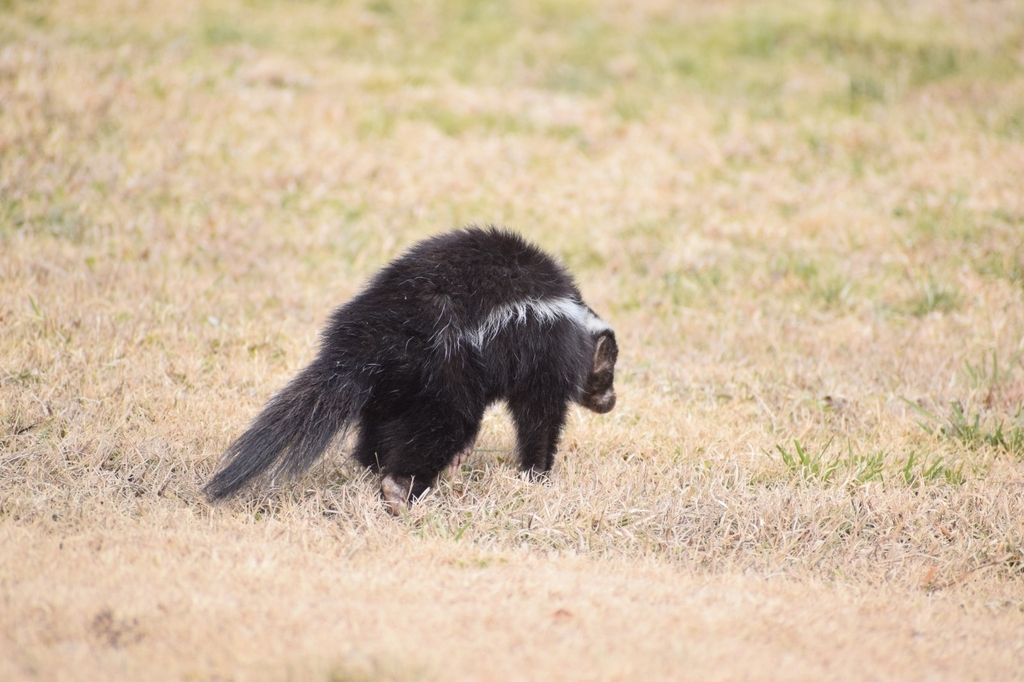
The Striped Hog-nosed Skunk combines the elongated snout typical of its genus with a pattern of two separate dorsal stripes, intermediate between the markings of Conepatus leuconotus and those of skunks in the genus Mephitis. It ranges from southern Mexico through much of South America, occupying a variety of open and wooded habitats. A born digger, it travels the ground rooting for invertebrates at night. Its wide geographic range makes it one of the most widespread Neotropical mephitids.
Head-and-body length 30-49 cm with a tail of 16-30 cm; weight 1.5-3.5 kg. The coat is black with two distinct white dorsal stripes that split towards the shoulders, unlike the single broad stripe of C. leuconotus. The long, hairless snout is shared with the rest of the genus. It differs from Mephitis mephitis, with which it may overlap in the north of its range, in its much more elongated and flexible snout.
Tracks and signs include five-toed tracks with long fore claws adapted for digging. Small conical scrapes are frequently found in soft soil where it has searched for invertebrates, similar to other Conepatus species. Burrows are usually located under rocks, logs or on embankments. The musky odour of its defensive secretion is intense and persistent, and is often detected before sighting the animal.
Tropical forests, savannas and scrubland, from sea level to nearly 3000 m, from southern Mexico to northern South America.
Feeds mainly on invertebrates obtained by rooting in the soil, as well as small vertebrates and fruit on occasion.
Nocturnal and solitary, it moves slowly across the ground searching for food. When facing potential threats, it relies on its warning colouration and defensive secretion rather than fleeing.
Retains a very wide distribution and tolerates habitats altered by human activity, suggesting globally stable populations despite the scarcity of specific studies across much of its range.
The conversion of natural habitat for agricultural and livestock use, along with roadkill, are the most frequently cited pressures.
See all species accounts for carnivores · Full species index
Mammaling is a free app for logging the mammals you find. You record a sighting in a moment — even if it's just a track — your life list grows, and the record becomes available to scientific and conservation projects.
It runs on your phone with nothing to install. If you like, it adds to your home screen like any other app.
Open Mammaling