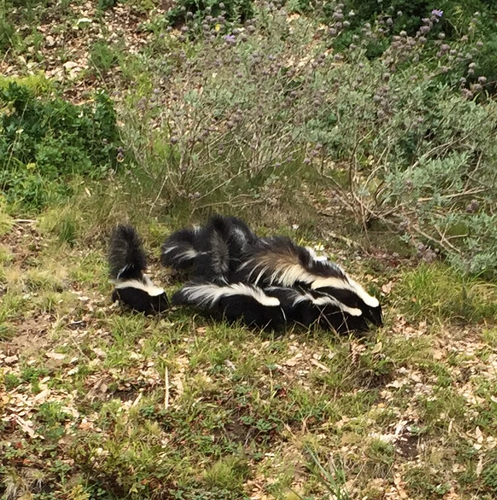
Before resorting to its famous chemical defence, it gives warning with a highly recognisable sequence of behaviours: it stamps its forefeet, arches its tail and sometimes performs a handstand on its forelegs, giving a potential attacker several opportunities to back off before receiving a blast from its anal glands. Sprayed accurately up to several metres, this oily liquid contains sulphur compounds so persistent that they can be detected over a kilometre away, and are almost impossible to remove completely from skin or fur without specific treatment. Its striking black coat with white stripes acts as a long-distance warning to any predator that has already learned, usually from experience, to associate that pattern with an unpleasant response. It lives in a huge variety of North American habitats, from forest to prairie and urban areas, where it digs for insects and small vertebrates on almost any night of the year, except in the depth of northern winters.
A medium-sized mustelid with a black coat featuring two white stripes that originate at the nape and run along the back to the very bushy, conspicuous tail. The Striped Skunk is distinguished from other skunk species within its range by the specific pattern of its dorsal stripes, and from any other mammal by a black-and-white combination so recognisable even at night.
Tracks and signs show 5 toes on each foot with long, clearly visible claw marks. The foretrack is 3-4 cm long, with a shuffling, poorly defined gait compared to the agile trot of a sleeker mustelid. Cylindrical droppings 5-7 cm long contain visible insect remains and seeds, deposited without any fixed pattern across its home range. More characteristic than the track is the scent: small, conical scrapes in turf or soil where it has dug for insect larvae, and, following a recent alarm, a strong, persistent sulphurous smell in the area, sometimes accompanied by yellowish stains of the oily liquid on nearby vegetation.
Extremely varied, from open woodland and prairie to scrubland and urban or suburban areas, from lowlands to mid-mountain elevations. Distributed across much of North America, from southern Canada to northern Mexico.
Omnivorous, feeding on insects, larvae, small vertebrates, eggs, fruit and carrion, digging in the soil with its long foreclaws.
Solitary outside the breeding season and nocturnal. It remains inactive during periods of intense cold in underground dens, without entering true hibernation. When threatened, it follows a highly recognisable warning sequence before spraying liquid from its anal glands as a last defensive resort.
Populations are considered stable across virtually its entire broad range, favoured by its great adaptability to human-altered habitats.
It faces no significant threats at species level. Locally, roadkill is a factor and it is a frequent carrier of rabies, which leads to control measures in some areas.
See all species accounts for carnivores · Full species index
Mammaling is a free app for logging the mammals you find. You record a sighting in a moment — even if it's just a track — your life list grows, and the record becomes available to scientific and conservation projects.
It runs on your phone with nothing to install. If you like, it adds to your home screen like any other app.
Open Mammaling