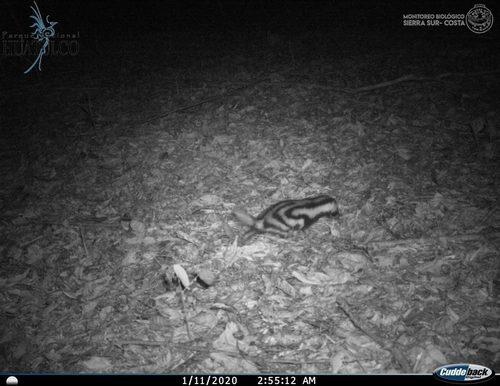
It is the smallest skunk in the world, barely the size of a large squirrel, yet it retains the same ability to spray an intensely foul-smelling liquid as its larger relatives. This defensive strategy is first announced with a striking handstand posture on the forelegs before spraying. The Pygmy Spotted Skunk lives in tropical dry forest and coastal scrub along the Mexican Pacific slope—a habitat type that changes radically in appearance between the wet season, when it suddenly flushes green, and the dry season, when much of the vegetation drops its leaves. Unlike larger skunks, it moves with greater climbing agility, ascending shrubs and low trees in search of prey or shelter. Its small body size, unusual among mephitids and their kin, makes it a rarity among American carnivores displaying warning patterns of stripes or spots.
A tiny carnivore, the smallest skunk in the world, with black fur marked by irregular white spots and stripes across the entire body, and a relatively short, bushy tail. It is distinguished from larger spotted skunks in the region by its much smaller size—almost half their size—and its preference for tropical dry forest and dense scrub over more open habitats.
Track small, 2-2.5 cm, with 5 toes and visible non-retractable claws, smaller than those of other spotted skunks in the region. Droppings elongated and twisted, 3-4 cm long, containing insect and small vertebrate remains, left at latrines near shelters beneath logs or in hollows within dense vegetation. Before spraying its defensive secretion, it adopts a characteristic handstand posture on its forelegs with its tail raised—a visual display that can sometimes be observed from a safe distance before the animal fires.
Tropical dry forest and coastal scrub in lowlands near the Pacific coast. Distributed along a narrow strip of Mexico's Pacific coast, from southern Sinaloa to Oaxaca.
Omnivorous, feeding on insects, small vertebrates, eggs and fruits found in the tropical dry forest and coastal scrub it inhabits.
Solitary and nocturnal, with climbing skills that allow it to ascend shrubs and low trees in search of prey or shelter—an unusual trait among skunks. Before resorting to its defensive secretion, it warns potential predators with a characteristic handstand posture on its forepaws.
Populations are considered to be in decline due to the ongoing loss of the tropical dry forest and coastal scrub on which it depends, one of the most threatened and least protected ecosystems along Mexico's Pacific coast.
Deforestation and fragmentation of tropical dry forest driven by agricultural, livestock and tourist expansion along the Pacific coast of Mexico.
See all species accounts for carnivores · Full species index
Mammaling is a free app for logging the mammals you find. You record a sighting in a moment — even if it's just a track — your life list grows, and the record becomes available to scientific and conservation projects.
It runs on your phone with nothing to install. If you like, it adds to your home screen like any other app.
Open Mammaling