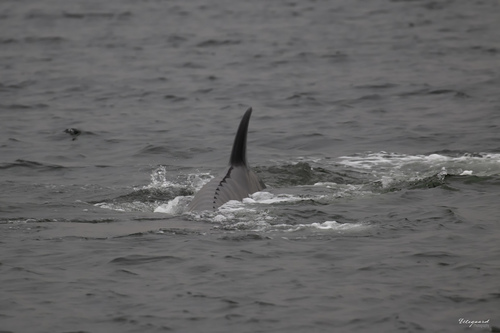
The Northern Bottlenose Whale is one of the animal kingdom's most extreme divers, capable of descending more than 1500 metres and remaining submerged for over an hour in search of deep-water squid. For years, this record was challenged only by the Sperm Whale.
The Northern Bottlenose Whale lives in cold, deep North Atlantic waters. For centuries, it was so unafraid of ships that whalers exploited its curiosity and its habit of coming to the aid of injured companions. This allowed them to hunt several individuals from the same group at once, a behaviour that contributed decisively to its historical decline.
The Northern Bottlenose Whale has one of the most pronounced beaks of all beaked whales, with a very characteristic bulging forehead that becomes more pronounced with age in males. Despite this, it remains one of the least known whales to the general public.
The Northern Bottlenose Whale is a medium-large cetacean with a robust, greyish-brown body and a well-defined beak. It has a very prominent, domed forehead (melon) which becomes more pronounced with age, especially in males, until it is almost vertical. It differs from other beaked whales in its area by its very prominent melon and its larger size than most of its relatives.
The Northern Bottlenose Whale leaves no tracks on land. It is detected by a low, inconspicuous blow, directed slightly forwards, and by very prolonged dives that can exceed an hour, followed by several minutes breathing at the surface before the next. Underwater, it produces very high-frequency echolocation clicks, adapted for hunting in the complete darkness of very deep waters. It is commonly observed in small, cohesive groups that remain together even in the presence of vessels, a behaviour that historically facilitated its hunting.
Cold, very deep oceanic waters of the North Atlantic, associated with submarine canyons and deep-water areas where their squid prey are abundant. Distributed throughout the North Atlantic, from New England to the Arctic and from the Azores to Svalbard.
It feeds almost exclusively on deep-water squid, caught during very prolonged dives using echolocation in complete darkness.
The Northern Bottlenose Whale lives in small, highly cohesive groups, with a strong tendency to remain with injured or distressed individuals instead of fleeing. This behaviour greatly facilitated its mass hunting in the past. It makes extensive movements in open sea rather than strict, well-defined seasonal migrations.
After centuries of intensive hunting decimated much of its historical populations, the Northern Bottlenose Whale is now considered to be of less concern than previously thought until a few years ago. This is thanks to recent assessments that have improved understanding of its true abundance in the North Atlantic.
Noise pollution from seismic surveys and naval sonar in deep-water feeding areas, occasional entanglement in deep-water fishing gear, and ingestion of plastic waste.
See all species accounts for even-toed ungulates · Full species index
Mammaling is a free app for logging the mammals you find. You record a sighting in a moment — even if it's just a track — your life list grows, and the record becomes available to scientific and conservation projects.
It runs on your phone with nothing to install. If you like, it adds to your home screen like any other app.
Open Mammaling