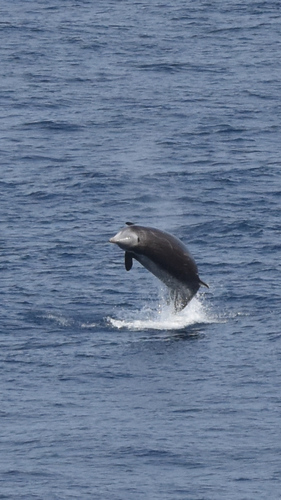
Cuvier's Beaked Whale holds the record for the deepest and longest dive ever recorded in a mammal, with documented dives exceeding 2900 metres deep and almost three and a half hours underwater. These figures surpass even those of the Sperm Whale, making Cuvier's Beaked Whale the most extreme diver known in the animal kingdom. It is the most cosmopolitan of all beaked whales, found in deep waters of practically all the world's oceans. This is unusual for a group of cetaceans generally restricted to much more specific areas. Its study history is marked by a recurring tragedy. In several regions of the world, including the Mediterranean, Cuvier's Beaked Whale has been repeatedly linked to anomalous mass strandings coinciding with naval exercises using mid-frequency sonar. This link has changed how the navies of several countries regulate their manoeuvres in sensitive areas.
Cuvier's Beaked Whale is a medium-large cetacean with a robust body, varying from dark grey to reddish-brown. In adult males, the head and back are often much lighter due to accumulated bite scars and barnacles. It has a short snout, giving a goose-like head profile, and a single pair of visible teeth at the tip of the male's lower jaw.
It differs from other beaked whales by its distinctive head profile and the extensive, light scarring pattern typical of adult males.
Cuvier's Beaked Whale does not leave tracks on land. Its behaviour at sea is extremely discreet, involving extraordinarily deep and prolonged dives, the most extreme known among mammals. These are followed by brief periods at the surface, with a low, barely visible blow slightly directed forwards. Most records of Cuvier's Beaked Whale come from strandings on beaches. These sometimes coincide with anomalous mass stranding events related to mid-frequency naval sonar activity. This phenomenon is better documented in Cuvier's Beaked Whale than in almost any other cetacean.
Cuvier's Beaked Whale is found in very deep oceanic waters worldwide, generally over the continental shelf and in submarine trenches. It is the most widely distributed of all beaked whales. It is present in the Atlantic, Pacific, and Indian Oceans, and deep seas such as the Mediterranean. The local subpopulation in the Mediterranean has been assessed separately in a more critical threat category than the species globally.
It feeds mainly on very deep-water squid, supplemented with mesopelagic fish, captured by suction during extremely deep and prolonged dives.
Solitary or in small, loosely cohesive groups, Cuvier's Beaked Whale exhibits the deepest and most prolonged diving pattern known among mammals. This keeps it out of human sight for the vast majority of its life. Adult males accumulate combat scars over the years, visible as parallel lines on the skin. These probably result from confrontations over access to females.
Globally, Cuvier's Beaked Whale remains numerous thanks to its very wide oceanic distribution. However, the Mediterranean subpopulation is much smaller and exposed to intense naval activity. It has been assessed separately in a more critical threat category than the species as a whole.
Submarine acoustic pollution from mid-frequency naval sonar is strongly linked to anomalous mass strandings in Cuvier's Beaked Whale more than any other species. Other threats include bycatch in deep-sea fishing gear, and ingestion of plastic and other marine debris frequently recorded in necropsies.
See all species accounts for even-toed ungulates · Full species index
Mammaling is a free app for logging the mammals you find. You record a sighting in a moment — even if it's just a track — your life list grows, and the record becomes available to scientific and conservation projects.
It runs on your phone with nothing to install. If you like, it adds to your home screen like any other app.
Open Mammaling