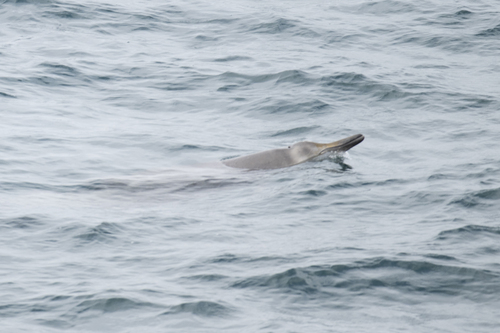
Sowerby's Beaked Whale is one of the least-sighted cetaceans in the entire North Atlantic. This deep-diving, elusive species is known to science almost entirely from dead animals stranded on the coast, rather than from direct sightings at sea.
Adult males bear a single pair of teeth. These are not used for chewing, as Sowerby's Beaked Whale feeds by suction. Instead, they emerge visibly from the sides of the lower jaw, even when the mouth is closed. This feature, in
A medium-sized cetacean with an elongated, fusiform body, dark grey to brown colouring, a small head with a moderately long beak, and in adult males, a single pair of teeth visible on both sides of the lower jaw, approximately halfway along its length. It is confused with other similarly sized beaked whale species, especially at sea, where reliable species-level identification usually requires close observation of the teeth's position in males or examination of a stranded specimen.
It leaves no tracks on land. Its behaviour at sea is extremely discreet, with very deep and prolonged dives followed by brief periods at the surface with a low, barely visible blow. This makes it very difficult to detect even at close range. The vast majority of records for the species come from beach strandings. Here, the position of the teeth in the male's jaw is the most reliable feature for confirming the species against other similar-looking beaked whales.
Deep oceanic waters of the North Atlantic, generally over the continental slope and in deep areas far from the coast.
Distributed throughout the North Atlantic, from the east coast of North America to European coasts. There are very few direct at-sea records due to its elusive behaviour and deep dives.
It primarily feeds on deep-water squid, caught by suction during dives that can reach over a thousand metres deep.
Sowerby's Beaked Whale is solitary or found in small, loosely cohesive groups. Its extremely deep and prolonged diving behaviour keeps it out of human sight for most of its life.
Its reproductive and social biology remains poorly understood compared to other better-studied cetaceans.
The lack of direct population data, stemming from its elusive behaviour and the fact that many records come from strandings, makes it difficult to precisely determine the trend of Sowerby's Beaked Whale populations. However, the most recent global assessment found no clear signs of widespread decline.
Underwater noise pollution from naval sonar has been linked to anomalous strandings in several similarly behaving Beaked Whale species. Occasional bycatch occurs in deep-sea fishing gear. Plastic ingestion has been documented in necropsies of stranded animals.
See all species accounts for even-toed ungulates · Full species index
Mammaling is a free app for logging the mammals you find. You record a sighting in a moment — even if it's just a track — your life list grows, and the record becomes available to scientific and conservation projects.
It runs on your phone with nothing to install. If you like, it adds to your home screen like any other app.
Open Mammaling