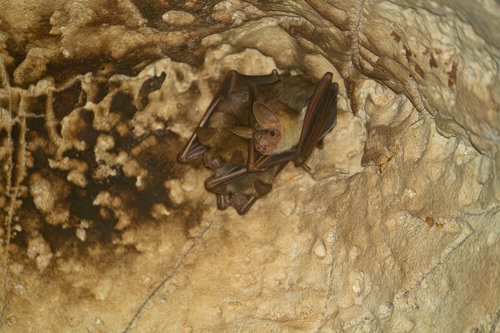
The Lesser Myotis is the almost identical sibling of the Greater Mouse-eared Bat, so similar in appearance, sound, and behaviour that its widespread distribution across much of southern Europe was long underestimated. It mainly hunts grasshoppers and crickets in open grassland areas, often locating them by the sound of their own calls and stridulations rather than by active echolocation. This is a passive hunting strategy shared with very few European bats. It forms breeding colonies that can gather thousands of individuals in large, warm caves. These are often mixed with those of its sister species, forming some of the largest concentrations of bats in all of Europe.
The Lesser Myotis is a large bat, one of the largest in Europe, with greyish-brown fur, large ears and a robust muzzle. It is practically indistinguishable in the hand from the Greater Myotis, differing only by very subtle skull details, muzzle colour and forearm length. In practice, reliable identification between the two species almost always requires capture and careful measurement.
Peak energy frequency between 28 and 32 kHz. FM-type pulse with an almost constant component at the end when hunting in open areas, visible on the detector as an initially sloped trace that flattens slightly. Long duration, 8-15 milliseconds long.
Cannot be reliably distinguished from the Greater Mouse-eared Bat by sonogram. Both species emit a virtually
Open grassland, steppe, and low scrub for hunting, with shelter in large, warm caves, from lowlands to mid-mountain areas. Distributed across Southern Europe, North Africa, and much of Central and Southern Asia.
The Lesser Myotis is an insectivore specialising in grasshoppers and crickets of open grassland. It largely locates these prey by the sound of their own stridulations, rather than by active echolocation.
The Lesser Myotis forms very numerous breeding colonies, often mixed with those of its sister species. These are found in large, warm caves, and the species shows strong fidelity to the same roost year after year. It is very sensitive to human disturbance during breeding and hibernation, when it occurs in dense aggregations of thousands of individuals.
Its populations are generally considered stable across most of its range, though locally sensitive to the loss of large, suitable breeding caves and to the degradation of open pasture areas it depends on for hunting.
Disturbance in large breeding and hibernation caves, loss of open pasture and steppe areas due to agricultural intensification or abandonment of traditional grazing, and use of insecticides, which reduces the availability of grasshoppers and crickets.
See all species accounts for bats · Full species index
Mammaling is a free app for logging the mammals you find. You record a sighting in a moment — even if it's just a track — your life list grows, and the record becomes available to scientific and conservation projects.
It runs on your phone with nothing to install. If you like, it adds to your home screen like any other app.
Open Mammaling