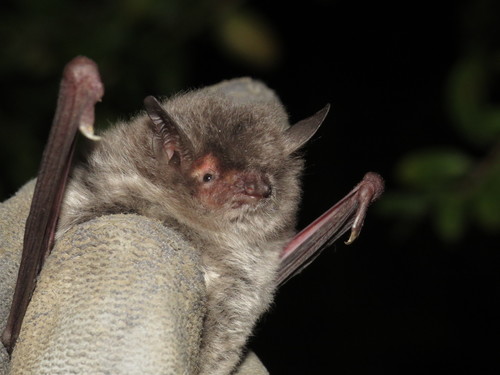
The Long-fingered Myotis is one of the few European bats that hunts by skimming the water surface with its hind feet, almost like a small nocturnal kingfisher, dragging them through the water to spear insects and even small fish. It lives in colonies that depend entirely on caves and mines with a very specific, warm and humid microclimate, making it extremely sensitive to any alteration of these roosts. It often shares caves with other cave-dwelling bat species, sometimes forming mixed colonies of thousands of individuals. These are among the least known wildlife spectacles of the Mediterranean basin.
A small to medium-sized bat, the Long-fingered Myotis has greyish-brown fur on its back, paler fur on its belly, and large, robust hind feet with stiff hairs adapted for trawling. Its ears are short compared to other Myotis species.
It can be confused with Daubenton's Bat (Myotis daubentonii), which has similar hunting habits over water. The Long-fingered Myotis is distinguished by its proportionally larger foot and by almost always associating with cave roosts instead of trees or bridges
Peak energy frequency between 40 and 55 kHz. The pulse is FM (frequency modulated), with a pronounced downward sweep. On the detector screen, this appears as a curved, sloping trace, typical of the genus Myotis. Pulse duration is very short, 2 to 4 milliseconds long, with intervals that shorten considerably when approaching the water surface during hunting. The Long-fingered Myotis is difficult to separate reliably from other Myotis based on the sonogram alone. Identification should be supported by its low-level flight behaviour over water and, whenever possible, by capture or genetic analysis.
Under occupied cave entrances, fine, granular guano may accumulate in piles beneath roosting points, alongside urine stains on nearby rock walls; it emerges shortly after sunset to fly directly to nearby water bodies.
Roosts in caves, mines, and other warm, humid underground refuges for daytime rest, hunting almost always over slow-moving watercourses, reservoirs, and nearby ponds.
Distributed throughout the Mediterranean basin, from the Iberian Peninsula and North Africa to the Near East, at generally low and medium altitudes.
Insectivorous, the Long-fingered Myotis captures aquatic and terrestrial insects flying over the water surface, dragging its hind feet through the water to gaff them; occasional capture of small fish has also been documented.
The Long-fingered Myotis forms very numerous breeding colonies, often mixed with other cave-dwelling species. It shows strong fidelity to the same underground roost year after year. It is very sensitive to human disturbance in breeding and hibernation caves, where it can spend the winter in dense groups.
Long-fingered Myotis populations are declining in much of the Mediterranean basin due to the loss and alteration of underground roosts, although some large colonies protected in managed caves remain relatively stable.
Alteration and closure of caves and mines used as roosts, along with human disturbance and unregulated caving, pose threats to breeding and hibernation colonies. Further issues include pollution and degradation of watercourses where the Long-fingered Myotis hunts, and loss of connectivity between roosts.
See all species accounts for bats · Full species index
Mammaling is a free app for logging the mammals you find. You record a sighting in a moment — even if it's just a track — your life list grows, and the record becomes available to scientific and conservation projects.
It runs on your phone with nothing to install. If you like, it adds to your home screen like any other app.
Open Mammaling