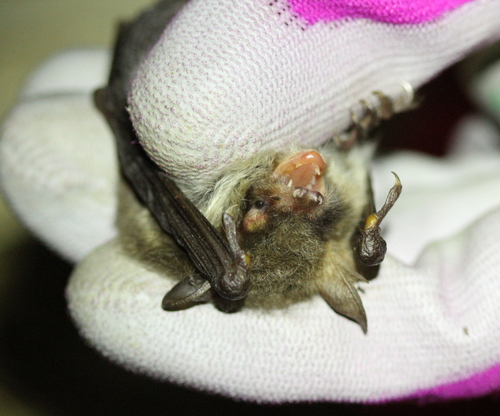
Its very name reveals what makes the Cryptic Myotis special. For decades, it was confused with the European Natterer's Bat. Genetic studies then revealed it was actually a distinct, Mediterranean species, visually indistinguishable from its counterpart. It is a slow-flying hunter, highly manoeuvrable in dense vegetation, capable of picking perched insects directly from leaves instead of always pursuing them in flight
The Cryptic Myotis is a small to medium-sized bat with greyish-brown fur, a whitish belly, and medium-sized ears. It has a fringe of stiff, curved hairs along the edge of the uropatagium, a feature shared with the entire Natterer's group. It is indistinguishable in the hand from Myotis escalerai and very similar to Myotis nattereri. Reliable species identification requires genetic analysis, as external and cranial characteristics overlap completely between the three species.
Maximum energy frequency between 35 and 90 kHz, with most energy concentrated around 45-55 kHz. Broadband FM pulse, with a very pronounced sweep that appears as an almost vertical, short trace on the detector. 2-5 milliseconds long, with pulses emitted in denser bursts when hunting near foliage.
The Cryptic Myotis cannot be reliably separated from Myotis escalerai or Myotis nattereri by sonogram. The three species in the complex share a practically identical acoustic pattern, and identifying the exact species by sound alone is a common identification error that must be avoided. Under feeding perches in woodland, moth wings and other prey remains cut with the jaws may be found. Small, fibrous guano will also be scattered on the ground. The Cryptic Myotis emerges relatively late, well into twilight.
Well-preserved deciduous and mixed woodland, with a preference for areas with dense undergrowth and proximity to water, from lowlands to mid-mountain areas.
Distributed across southern Europe, with the bulk of its range in the Iberian Peninsula, southern France, and Italy.
An insectivore, slow-flying among vegetation, it captures moths, spiders and other invertebrates both in flight and by gleaning them directly from leaves and branches.
Cryptic Myotis forms small to medium-sized breeding colonies in tree hollows, rock crevices, and bat boxes, frequently changing roosts within the same forest throughout the season. Its slow, manoeuvrable flight allows it to exploit very confined spaces that other larger-winged species cannot use.
Described so recently, information on Cryptic Myotis population trends is still limited. However, it is generally considered stable in well-preserved forest areas where it has been studied.
Loss and simplification of mature forest with tree hollows available for shelter; intensive forest management removing old trees; and the use of insecticides, reducing prey availability.
See all species accounts for bats · Full species index
Mammaling is a free app for logging the mammals you find. You record a sighting in a moment — even if it's just a track — your life list grows, and the record becomes available to scientific and conservation projects.
It runs on your phone with nothing to install. If you like, it adds to your home screen like any other app.
Open Mammaling