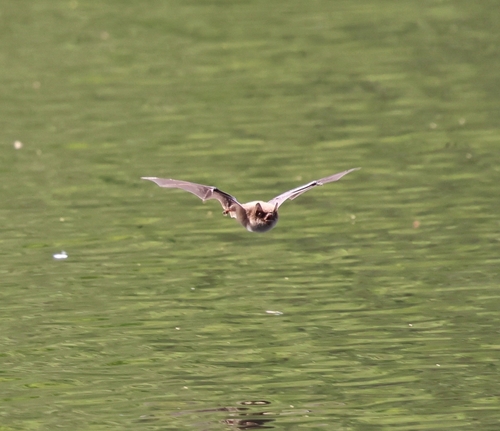
It flies skimming the water surface with astonishing precision, harpooning insects and sometimes small aquatic invertebrates directly with its hind feet or tail membrane in low-level flight. This hunting technique makes it easy to recognise even without a bat detector, simply by watching its low, steady flight a few centimetres above calm water on a river or canal. It is one of Europe's most studied bats precisely because of this predictable behaviour, which makes it easy to count with a torch from the bank on summer nights. It roosts mainly in tree holes and under bridges near water—two types of structure that can become scarce in heavily modified landscapes just where they are needed most.
A small- to medium-sized bat with greyish-brown dorsal fur and silvery-white belly fur, showing a marked contrast between the two colours. It has short ears and large feet with stiff hairs adapted for trawling. It can be confused with Long-fingered Bat, which is larger with even more developed feet, and Pond Bat, from which it differs by roosting mainly in trees and bridges rather than caves.
Peak frequency between 35 and 45 kHz. FM-type pulse with a pronounced sweep, visible on the detector as a curved, sloping trace typical of the genus Myotis. Duration is short, 2 to 4 milliseconds, with pulse intervals shortening greatly as it approaches the water surface while hunting. It is difficult to separate reliably from other small Myotis species by the sonogram alone; steady skimming flight over water is the most reliable behavioural track and sign to support field identification. Beneath bridges and tree holes used as roosts, fine, granular guano accumulates in elongated piles, alongside urine stains on nearby stone or bark. It emerges shortly after sunset, heading straight for the water.
Slow-flowing watercourses, canals, lakes and ponds, roosting in riparian tree holes, bridges and structures near water, from lowlands up to mid-mountain areas. Distributed across much of Europe and Asia, from the United Kingdom to Japan.
Insectivorous, catching insects that fly over the water surface by dragging its hind feet and tail membrane through the film to harpoon them in low flight.
Forms nursery colonies in tree holes and under bridges near water, making relatively short movements between roost and hunting grounds. It is one of the best-studied bat species in Europe thanks to its predictable hunting behaviour over water.
Maintains large and generally stable or slightly expanding populations across much of Europe, favoured by the availability of artificial structures such as bridges that it can use as alternative roosts to natural tree holes.
Loss of riparian tree holes through intensive forestry management, pollution and degradation of watercourses where it hunts, and to a lesser extent, restoration of old bridges that removes crevices used as roosts.
See all species accounts for bats · Full species index
Mammaling is a free app for logging the mammals you find. You record a sighting in a moment — even if it's just a track — your life list grows, and the record becomes available to scientific and conservation projects.
It runs on your phone with nothing to install. If you like, it adds to your home screen like any other app.
Open Mammaling