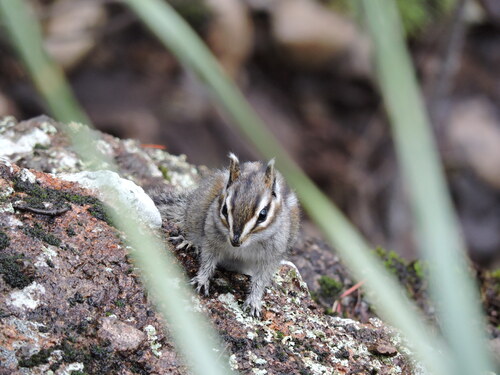
One of the southernmost chipmunks in the entire Americas, this group of small rodents is far more associated in the popular imagination with North American temperate forests than with the tropical Mexican mountains where this species lives. It moves nimbly among rocks and fallen logs in mountain pine-oak forest, packing seeds into its cheek pouches to carry to caches used during months when food is scarce. Like all chipmunks, its back is striped with alternating pale and dark longitudinal bands that provide camouflage in the dappled light and shade of the understorey. Its distribution, restricted to a fragment of the Sierra Madre Occidental, gives Buller's Chipmunk one of the smallest home ranges of any member of its genus.
Small squirrel with a slender body, alternating pale and dark longitudinal bands along the back, and a moderately long, bushy tail. Buller's Chipmunk is distinguished from other North American chipmunks by its exclusive distribution in Mexico's Sierra Madre Occidental, with no overlap with related species from further north.
Small tracks and signs, the hind track 2.5-3 cm long, with 5 hind toes and 4 front toes, similar to those of other chipmunks in the region. Droppings small and elongated, 6-8 mm long, left scattered alongside fallen logs and rocky outcrops. It digs shallow burrows beneath roots or rocks, with the entrance partially concealed, and leaves accumulations of seed hulls and gnawed pine nuts at regular feeding spots on logs or flat rocks.
Mountain pine-oak forest with a rocky understorey, generally between 2000 and 3000 m altitude. Endemic to an area of the Sierra Madre Occidental in western Mexico.
Omnivorous, feeding on seeds and pine nuts stored in caches, as well as fruit, fungi and the occasional invertebrate from the forest floor.
Diurnal and terrestrial, though an occasional climber, storing seed reserves in underground caches or beneath rocks for months when food is scarce. Solitary outside the breeding season.
Populations are considered to be declining due to the ongoing loss of the mountain pine-oak forest on which it depends, within a distribution already restricted to a specific area of the Sierra Madre Occidental.
Deforestation and fragmentation of pine-oak forest through logging and land-use changes in the Sierra Madre Occidental.
See all species accounts for rodents · Full species index
Mammaling is a free app for logging the mammals you find. You record a sighting in a moment — even if it's just a track — your life list grows, and the record becomes available to scientific and conservation projects.
It runs on your phone with nothing to install. If you like, it adds to your home screen like any other app.
Open Mammaling