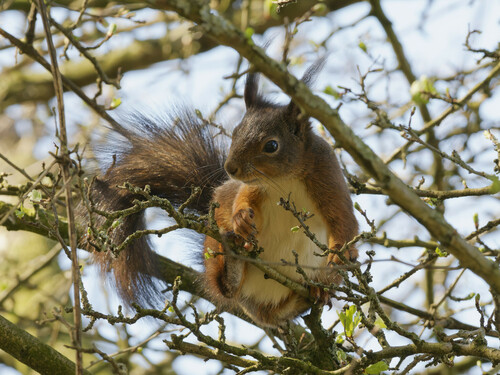
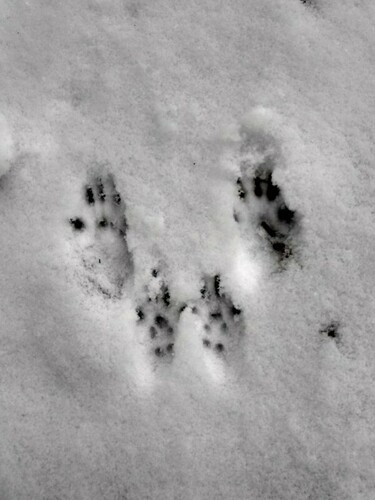
Illustration generated with artificial intelligence from reference sources and reviewed by the team. Use it as a guide, not as a definitive identification key: it may contain errors in anatomical details such as the number of toes, claw marks or the scale. If something looks off, write to us at [email protected]: corrections from people who know the field are what keep improving these plates.
The Eurasian Red Squirrel is the squirrel most Europeans imagine: reddish, with prominent ear tufts, and a common presence in coniferous forests from the Iberian Peninsula to Siberia. But its recent history has a darker side: in the United Kingdom, Ireland, and Italy, it has suffered a sharp decline since the arrival of the North American Grey Squirrel, to the point of disappearing from areas where it was once the dominant species. Outside these islands and Italy, however, it remains a common and stable presence in much of its range.
A medium-sized arboreal Eurasian Red Squirrel. Its fur is highly variable depending on population and season, ranging from intense reddish to dark brown or almost black. It always has a white belly and tufts of erect hair on its ears, which are especially visible in winter.
It can be confused with the introduced Grey Squirrel in areas where they overlap; the Grey Squirrel is notably larger and lacks ear tufts.
Track with 4 front toes and 5 hind toes, 3.5-4.5 cm long, slightly smaller than that of the Grey Squirrel, with sharp claw marks. Droppings are small and oval, 0.8-1.2 cm long, scattered under conifers and broadleaf trees where the Eurasian Red Squirrel feeds. It leaves gnawed pine cones with a characteristic spiral pattern, distinct from the more irregular gnawing of smaller rodents. It also builds globular nests of branches (dreys) in tree crowns.
Coniferous, deciduous and mixed forest, from lowlands to mountain areas. It is distributed across much of Europe and Asia, from the Iberian Peninsula to eastern Siberia. However, its range has contracted significantly in the United Kingdom, Ireland, and Italy due to competition with the introduced Grey Squirrel.
Omnivorous, primarily eating conifer seeds, nuts, and acorns. It also consumes shoots, fungi, and occasionally eggs and insects, storing food for winter.
Diurnal and arboreal, the Eurasian Red Squirrel is territorial. Activity is reduced in winter, but it does not truly hibernate, remaining active on mild days. It produces 1-2 litters of 3-4 young per year. Reproductive success is greater when conifer seeds are abundant.
The Eurasian Red Squirrel maintains stable and well-distributed populations across most of continental Europe and Asia. However, its range has contracted drastically in the United Kingdom, Ireland, and Italy since the introduction of the North American Grey Squirrel in the 19th and 20th centuries.
Competition and transmission of squirrelpox virus by the introduced Grey Squirrel, forest fragmentation, and roadkill in peri-urban areas.
See all species accounts for rodents · Full species index
Mammaling is a free app for logging the mammals you find. You record a sighting in a moment — even if it's just a track — your life list grows, and the record becomes available to scientific and conservation projects.
It runs on your phone with nothing to install. If you like, it adds to your home screen like any other app.
Open Mammaling