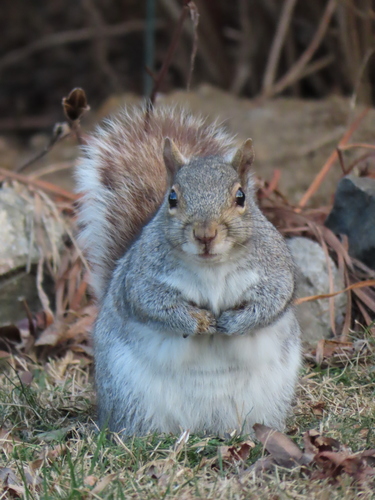
In its native North America, the Eastern Gray Squirrel is just another squirrel, playing no special role. In Europe, however, it has become one of the most studied invasive species on the continent. Wherever it was introduced, especially in the British Isles and Italy, it has displaced the native Red Squirrel. This is partly through direct competition and partly because it transmits a virus which does not affect the Eastern Gray Squirrel but is fatal to its European relative. It is a textbook example of how an apparently harmless species can transform an entire ecosystem without showing any signs of aggression.
The Eastern Gray Squirrel is a medium-large tree squirrel with grey fur, brownish reflections on the back and white on the belly, and a long, very bushy tail with pale edges. In its introduced range, it can be confused with the native Red Squirrel. It is distinguished by its larger size, grey colouring (compared to reddish), and the absence of ear tufts.
Track 4-5 cm long, with 4 fore toes and 5 hind toes, and sharp claw marks for climbing. Droppings small and oval, 1-1.5 cm long, scattered under frequently visited trees. It leaves gnawed pine cones and nuts, and builds globular nests of branches and leaves (dreys) in high tree forks. In areas where it coexists with the Red Squirrel, its presence alone often precedes the latter's disappearance within a few years.
Deciduous and mixed woodland, and urban parks with mature trees. Native to eastern North America, and introduced and widely established in parts of Western Europe (United Kingdom, Ireland, Italy) and South Africa.
Omnivorous, it eats nuts, seeds, shoots, bark, and occasionally eggs and insects; it stores food by burying it in scattered caches to retrieve in winter.
The Eastern Gray Squirrel is diurnal and arboreal. It is territorial but has overlapping home ranges. It breeds 1-2 times a year with litters of 2-4 young. In introduced areas, it competes with the Red Squirrel for food. It also acts as an asymptomatic carrier of the squirrelpox virus, which is lethal to the Red Squirrel but harmless to the Eastern Gray Squirrel itself.
The Eastern Gray Squirrel maintains stable and expanding populations both in its native North American range and in areas where it has been introduced. In these areas, its advance has been accompanied by a sharp decline in the native Red Squirrel.
In its native range, the Eastern Gray Squirrel faces no significant threats. In introduced areas, it poses a serious threat to the European Red Squirrel, which has led to control programmes in several countries.
See all species accounts for rodents · Full species index
Mammaling is a free app for logging the mammals you find. You record a sighting in a moment — even if it's just a track — your life list grows, and the record becomes available to scientific and conservation projects.
It runs on your phone with nothing to install. If you like, it adds to your home screen like any other app.
Open Mammaling