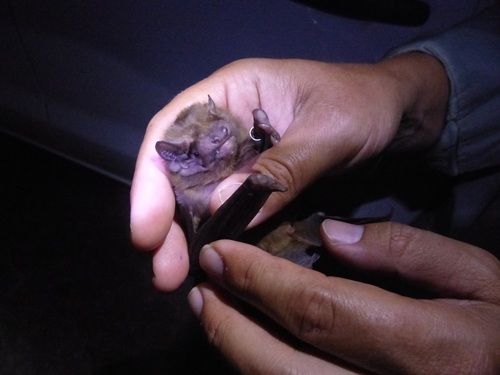
The largest bat in Europe, the Greater Noctule is the subject of one of the most surprising recent discoveries in mammalogy: it hunts migratory birds in full nocturnal flight, at high altitude. This was considered unthinkable for a bat until analysis of its droppings revealed feathers and remains of small passerines. Its wingspan, which can exceed 40 cm, and its high, swift, almost swift-like flight, make it very distinct from any other European bat. It emits calls of such low frequency that, in silent conditions and with good hearing, some people have managed to perceive its lowest pulses without the aid of any detector.
The Greater Noctule is the largest European bat, with a wingspan exceeding 40 cm, uniform reddish-brown fur, and short, rounded ears. It differs from the Common Noctule (Nyctalus noctula), a clearly smaller species, by its much larger wingspan. Its flight is high and fast in open country, often at dusk over large clearings or above the forest canopy.
Peak energy frequency 15-20 kHz. The pulse is QCF (quasi-constant frequency). On the detector screen, it appears as a low, barely inclined horizontal bar, one of the lowest among European bats. It has a relatively long duration, 12-20 milliseconds, with a wide pulse interval typical of high-altitude, open-space flight. It can be confused with the Common Noctule (Nyctalus noctula), whose lowest frequency may overlap with the Greater Noctule's highest. In areas of overlap, identification should be based on the size of the study area, flight height and, if possible, capture. Under tree hollows used as roosts, accumulations of large, fibrous guano can be found. Large insect wing remains and even small bird feathers may also be present under feeding perches. The Greater Noctule emerges relatively late after sunset and flies at high altitude from the outset.
Mature woodland with large hollow trees for roosting. It forages in open spaces and at high altitudes over woodland, wetlands and agricultural areas, from lowlands to mid-mountain zones. Its distribution is fragmented across southern and central Europe, North Africa and western Asia.
The Greater Noctule is insectivorous, mainly hunting large flying insects at high altitude. It has a documented ability to occasionally capture small migratory birds in full nocturnal flight.
The Greater Noctule forms breeding colonies in large tree hollows, with marked fidelity to mature forests with old trees. It undertakes seasonal movements of some distance between breeding and wintering areas, and its high, direct flight makes it less dependent on linear landscape features than other species.
Its populations are considered fragmented and declining across much of Europe, owing to the scarcity of mature woodland with large cavities. However, locally stable strongholds persist where old trees are preserved.
Loss of mature woodland with old trees and large cavities, forest management that removes senescent trees before they develop useful cavities, and collision with wind turbines during high-altitude flight.
See all species accounts for bats · Full species index
Mammaling is a free app for logging the mammals you find. You record a sighting in a moment — even if it's just a track — your life list grows, and the record becomes available to scientific and conservation projects.
It runs on your phone with nothing to install. If you like, it adds to your home screen like any other app.
Open Mammaling