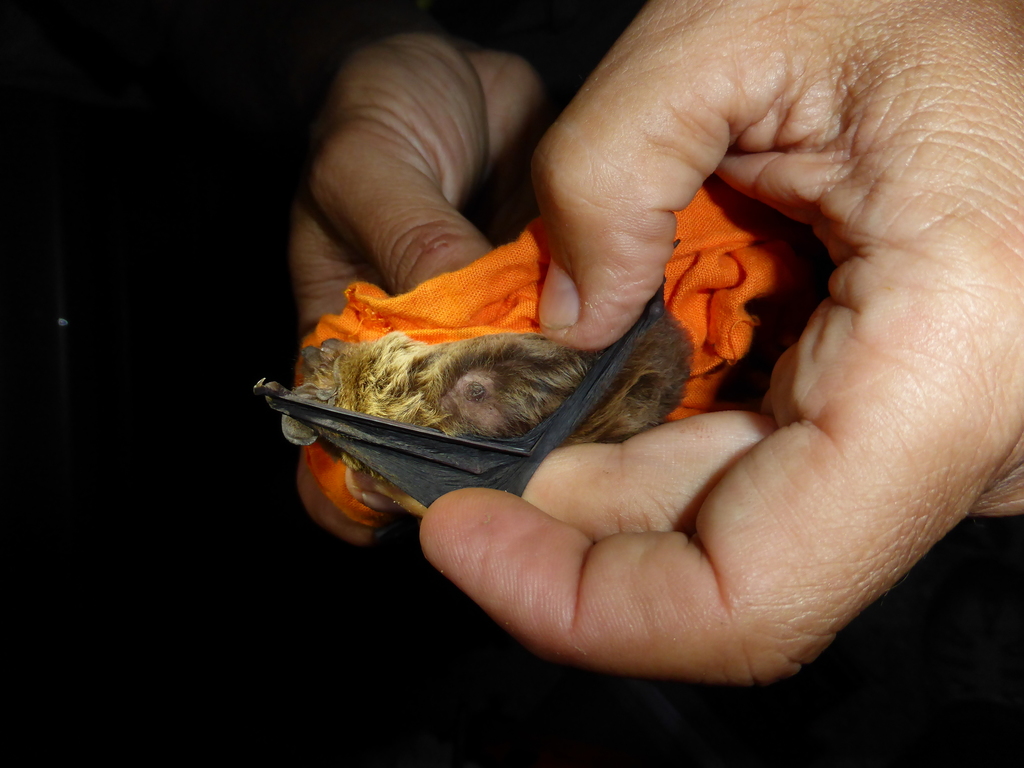
This high- and fast-flying bat exhibits a trait unusual among flying mammals: in parts of Europe, it makes seasonal migrations covering hundreds of kilometres between breeding and wintering grounds, whereas elsewhere—especially on certain western European islands—its populations remain entirely sedentary year-round. Such contrasting life strategies within a single species highlight how variable migratory behaviour can be, even between neighbouring populations. Smaller than its better-known relative, the Noctule, it nevertheless shares the same high, direct flight in open habitat, making it easy to spot at dusk as it crosses forest glades or flies well above farmland.
A medium-sized bat, smaller than the Noctule, with uniform glossy reddish-brown fur, short rounded ears, and fast, high flight in open spaces. It can be confused with the larger Noctule, as well as with the Serotine, which also flies high but somewhat more slowly. Intermediate size and peak call frequency are the most reliable features for distinguishing it from both species.
Peak frequency between 24 and 28 kHz. Calls are QCF pulses with a short initial FM sweep, appearing on the bat detector as a low-pitched horizontal bar with a slight slope at the start. Duration is long, from 8 to 15 milliseconds, with wide inter-pulse intervals typical of high flight in open space. Tracks and signs can be confused acoustically with the Noctule, which calls at a slightly lower frequency but overlaps significantly in the middle range, and with the Serotine; within this overlap zone, identification cannot be made with certainty from the sonogram alone, so size observations or physical capture are needed. Below tree hollows used as roosts, fibrous guano accumulates that is somewhat larger than that of small Myotis species, alongside insect wing fragments under feeding perches. It emerges relatively early, shortly after sunset, and flies high from the outset.
Mature woodland with tree hollows for roosts, foraging at height over open space above forest, wetlands and farmland, from lowlands up to mid-altitude mountains. Distributed across much of Europe, North Africa and parts of western Asia, with migratory populations in central and eastern Europe and sedentary populations in several western areas, including some islands.
Insectivorous, hunting medium-sized flying insects in high, direct flight, often over forest glades, wetlands and farmland.
Forms maternity colonies in tree hollows, displaying migratory behaviour that varies greatly between populations: some undertake seasonal movements of several hundred kilometres between breeding and wintering grounds, whereas others, notably in western Europe, remain sedentary year-round. Its high, direct flight makes it less reliant on linear landscape features than slower-flying species.
Populations are generally considered stable across most of its range, though there is some concern for certain migratory populations in central and eastern Europe, which face greater threats along long migration routes than sedentary western populations.
Loss of mature woodland containing old trees with hollows suitable for roosting, collisions with wind turbines during high flight—particularly affecting migratory populations—and insecticide use, which reduces prey availability.
See all species accounts for bats · Full species index
Mammaling is a free app for logging the mammals you find. You record a sighting in a moment — even if it's just a track — your life list grows, and the record becomes available to scientific and conservation projects.
It runs on your phone with nothing to install. If you like, it adds to your home screen like any other app.
Open Mammaling