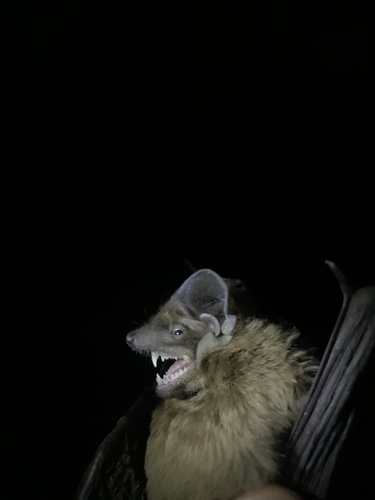
This is one of the few European bats whose deepest echolocation calls can be heard without a detector by a young person with good hearing—an unusual trait that has made the Common Noctule one of the most studied species on the continent. It flies high and fast in open countryside at dusk, with a direct, powerful flight style reminiscent of a small night-hunting falcon rather than the typical fluttering of other bats, hawking insects high over forest clearings, wetlands and cities. It undertakes seasonal migrations of hundreds of kilometres across much of its range, forming autumn concentrations of thousands of individuals at known bottlenecks while travelling to milder wintering grounds across several countries.
A medium-large bat with uniformly glossy reddish-brown fur, short, rounded ears, and a high, fast, direct flight in open space. It can be confused with the smaller Leisler's Bat and with the Serotine, which also flies high; its lower peak frequency and larger size are the most reliable characters for separating it from both.
Peak frequency between 17 and 22 kHz, among the lowest of common European bats. The call is a QCF type, appearing on the detector as a low, stable horizontal bar with almost no slope. Long pulse duration of 10-20 milliseconds, with a wide inter-pulse interval typical of high-altitude flight in open space. It is acoustically confusable with Leisler's Bat in the overlapping range of intermediate frequencies; in this band they cannot be reliably separated by sonogram alone, and identification should be supported by observed size or capture. Beneath tree cavities used as roosts, fibrous guano accumulates in large quantities due to the size of the colonies, alongside wing fragments from large insects under feeding perches. It emerges relatively early, shortly after sunset, flying high right from the start.
Mature woodland with tree cavities for roosting; it forages at considerable height over open forest, wetlands, parks and urban areas, from lowlands up to mid-mountain zones. Widespread across much of Europe and Asia, with major seasonal migratory movements between breeding grounds in central and eastern Europe and wintering areas further west and south.
Insectivorous, hunting medium-large flying insects high in direct flight, often over forest clearings, wetlands and urban parks, as well as around streetlights that attract insects.
Forms large breeding colonies in tree hollows, showing strong seasonal migratory behaviour across much of its range. It travels several hundred kilometres between breeding and wintering grounds, assembling in autumn concentrations of thousands of individuals at known bottleneck sites.
Populations are generally considered stable across most of Europe, although migratory populations are more exposed to concentrated threats at known bottlenecks than more sedentary species.
Loss of mature woodland with old trees and available roosting cavities, collisions with wind turbines during migration and high-altitude flight—a risk particularly relevant to this migratory species—and insecticide use that reduces prey availability.
See all species accounts for bats · Full species index
Mammaling is a free app for logging the mammals you find. You record a sighting in a moment — even if it's just a track — your life list grows, and the record becomes available to scientific and conservation projects.
It runs on your phone with nothing to install. If you like, it adds to your home screen like any other app.
Open Mammaling