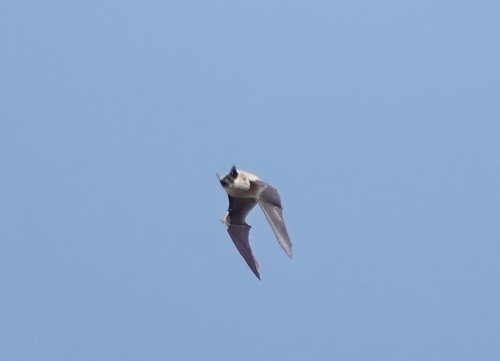
The Canyon Bat is the smallest bat in the United States. It is so light that its flight appears erratic and uncertain, almost like that of a large moth. This is very different from the straight flight of larger bats. It is also among the first to emerge each evening, often still in daylight. This is much earlier than most bats sharing its habitat of canyons and rocky deserts in western North America.
The Canyon Bat is barely 6-8 cm long, with a wingspan of about 18-19 cm. It has pale greyish-brown fur and dark ears and patagium that contrast with the rest of its body. It differs from other small bats in its range, such as Myotis bats, by its especially erratic and fluttering flight and by emerging to fly in more daylight than most of its neighbours.
Peak energy frequency between 41 and 53 kHz, with a typical value around 48 kHz. On the detector screen, the pulse shows a 'hockey stick' shape: a very steep, almost vertical, frequency-modulated (FM) sweep at the start, which softens into a low-slope tail below 47 kHz for most of the pulse. Pulses are usually consistent throughout a flight sequence, though sometimes they show small irregularities in the trace.
It can be acoustically confused with small Myotis bats that share its range. In areas of overlap, reliable separation also requires assessing the overall shape of the sequence, not relying on a single isolated pulse. Guano accumulates in small, loose piles under rocky crevices and overhangs where the Canyon Bat roosts during the day, without forming the bulky accumulations typical of large breeding colonies. It emerges to fly before dusk, with daylight still visible. This trait helps differentiate it in the field from strictly nocturnal species.
The Canyon Bat lives in rocky canyons, deserts and arid scrubland in the western United States and much of Mexico, sheltering in rock crevices, rock faces and occasionally buildings.
It feeds on small flying insects, such as mosquitoes, small moths, and beetles, caught in flight near rock faces and canyon vegetation.
The Canyon Bat is solitary or forms small, loosely cohesive groups in rock crevices. Its flight activity begins particularly early relative to sunset, compared to other bats in its range.
Listed as Least Concern by the IUCN, with a wide distribution across western North America, a presumably stable population, and presence in numerous protected areas.
Loss of rocky habitat from mining and urban development in parts of the southwestern United States, and the risk of pesticide exposure reducing their insect food, are the most cited pressures.
See all species accounts for bats · Full species index
Mammaling is a free app for logging the mammals you find. You record a sighting in a moment — even if it's just a track — your life list grows, and the record becomes available to scientific and conservation projects.
It runs on your phone with nothing to install. If you like, it adds to your home screen like any other app.
Open Mammaling