Each hair on its coat has three distinct colour bands: dark at the base, yellowish in the middle, and dark again at the tip. This detail, which gives the bat its common name, is only visible by blowing against the grain of the fur. For decades it was one of the commonest and most easily seen bats in eastern North America. However, the arrival of the fungus causing white-nose syndrome in the mid-2000s triggered a devastating population collapse across most of its hibernacula, with declines of up to 90-100% in some roosts. It is one of the smallest bats in North America, with a characteristically erratic, fluttering flight reminiscent of a large moth. Its situation has changed so rapidly in little over a decade that it went from being one of the most abundant species in its region to being proposed for federal endangered protection in several countries across its range.
Very small bat, one of the smallest in North America, with characteristic tricolored fur (dark base, yellowish middle, dark tip) visible when blowing the hair backwards. Ears and forearm are relatively short, and flight is erratic and fluttering. Separated from other small bats in its area by this unique tricolored fur pattern and its tiny size.
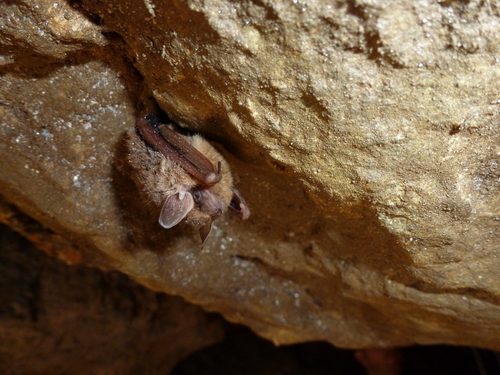
Peak energy frequency between 40 and 50 kHz at the start of the pulse, dropping to 22-28 kHz towards the end. FM-type pulse with a highly characteristic curved, hockey-stick or candy-cane shape on detector screens, distinct from the straighter, steeper slope of most Myotis species. Pulse duration is relatively long, 4-8 milliseconds, with inter-pulse intervals varying by flight phase. Confused acoustically with Nycticeius humeralis where their ranges overlap, as their frequency ranges partially coincide. The more curved, undulating shape of the Tricolored Bat's pulse compared to the more linear pulse of Nycticeius humeralis helps separate them, though partial or low-quality recordings cannot always be distinguished with certainty from the sonogram alone. Leaves accumulations of small, elongated guano a few millimetres long under summer roost crevices; this crumbles into fine insect dust when crushed. In winter it hibernates in caves and mines, hanging individually and often covered in condensation droplets that give it a characteristic glistening appearance.
Woodland, edge habitats, and areas near water in summer, using humid caves and mines for hibernation in winter. Distributed across much of eastern and central North America, from south-eastern Canada to Central America.
Insectivorous, hunting small flying insects on the wing, particularly near waterbodies and woodland edges.
Solitary or in small groups in summer, roosting among foliage or structures. Hibernates in winter in dispersed colonies inside humid caves and mines, where individuals hang separately rather than forming tight clusters like other species. Its erratic, fluttering flight, markedly different from the more direct flight of other bats, is a key field identifier.
Populations have suffered a catastrophic collapse since the arrival of white-nose syndrome in the mid-2000s, with declines of up to 90-100% in many hibernacula in eastern North America. No significant recovery has been observed in most affected areas.
White-nose syndrome, a fungal disease affecting bats during hibernation, is the primary threat and has caused the fastest, most severe decline documented in the species. It also suffers from woodland habitat loss and disturbance at hibernation roosts.
See all species accounts for bats · Full species index
Mammaling is a free app for logging the mammals you find. You record a sighting in a moment — even if it's just a track — your life list grows, and the record becomes available to scientific and conservation projects.
It runs on your phone with nothing to install. If you like, it adds to your home screen like any other app.
Open Mammaling