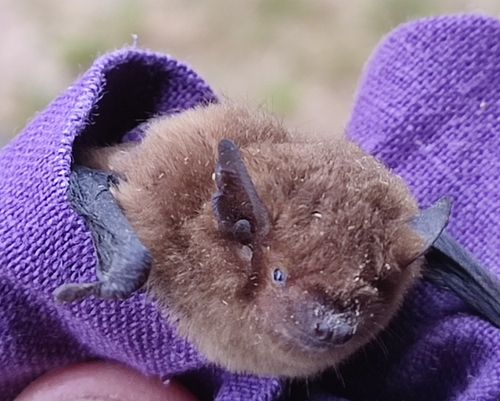
Nathusius's Pipistrelle is one of Europe's longest-distance migratory bats, capable of travelling up to 2000 km between its breeding areas in the northeast of the continent and its wintering areas in the southwest. This is a surprising feat for an animal that weighs barely more than a couple of coins. These mass migrations occur on specific dates in autumn, when thousands of individuals cross coastal areas and sea straits. Researchers have been trying to map these routes in detail for decades using ringing and telemetry.
Outside the migration season, Nathusius's Pipistrelle is an agile hunter of open spaces near water bodies, with a flight somewhat more direct than that of smaller pipistrelles.
Nathusius's Pipistrelle is a small bat, somewhat larger than the Common Pipistrelle, with dark reddish-brown fur and short, rounded ears. It is confused with the Common Pipistrelle and Kuhl's Pipistrelle, which are similar in size. The call frequency, intermediate between the two species, and the seasonal migratory context help guide identification, but do not fully guarantee it in areas of overlap.
Peak energy frequency between 39 and 43 kHz. FM-QCF pulse type: begins with a brief downward sweep that stabilises into an almost constant part, visible on the detector as an inclined trace flattening into a horizontal bar. Duration 5-10 milliseconds. It is acoustically confused with the Common Pipistrelle, which has a slightly higher frequency but with some overlap
Forest, wetland, and open water areas for hunting. Roosts are found in tree hollows and building crevices, from lowlands to mid-mountain areas.
Nathusius's Pipistrelle is distributed across much of Europe. Migratory populations move between breeding areas in the northeast of the continent and wintering areas in the southwest, including the Mediterranean basin.
Insectivorous, it hunts small flying insects over open water, wetlands, and forest clearings, with a relatively direct flight for its size.
Nathusius's Pipistrelle undertakes one of the longest known migrations among European bats. It travels up to 2000 km between breeding areas in northeast Europe and wintering areas in the southwest of the continent. It forms breeding colonies in tree hollows, and during autumn migration, it can form very large temporary concentrations at coastal stopover points.
Its populations are generally considered stable across most of its range. However, migratory populations are more exposed to threats concentrated along known migration routes and stopover points than sedentary populations of other species.
Collision with wind turbines during migration, a particularly relevant and well-documented risk for Nathusius's Pipistrelle, a long-distance migratory species; loss of mature woodland with available tree hollows; and the use of insecticides, which reduces prey availability.
See all species accounts for bats · Full species index
Mammaling is a free app for logging the mammals you find. You record a sighting in a moment — even if it's just a track — your life list grows, and the record becomes available to scientific and conservation projects.
It runs on your phone with nothing to install. If you like, it adds to your home screen like any other app.
Open Mammaling