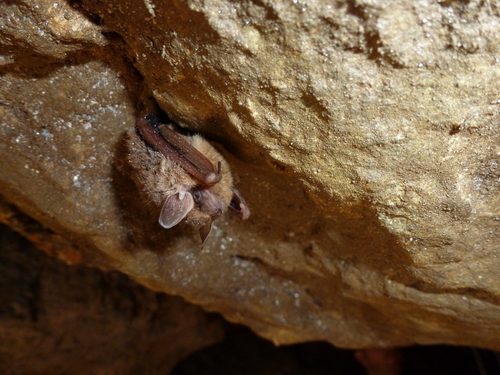
Weighing no more than a two-euro coin, the Common Pipistrelle can eat several thousand mosquitoes in a single night's hunting. This voracious appetite makes it one of the best natural allies against insects in towns and cities across half the planet.
It is one of Europe's most common bats, so accustomed to sharing roofs with people that many never notice a colony directly above their bedroom. For a long time, the Common Pipistrelle was thought to be a single, highly variable species. However, in the late 20th century, an analysis of its echolocation calls revealed it was actually two twin species, almost identical visually but hunting at different sound frequencies.
The Common Pipistrelle is a very small bat, among the smallest in Europe, with a forearm barely 3-3.5 cm long. It has uniform dark brown fur on its back, somewhat lighter on its belly, and short, triangular ears. Its flight is fast and erratic, typical of pipistrelles.
To the naked eye, it is practically indistinguishable from Nathusius' Pipistrelle and the Soprano Pipistrelle. Reliable differentiation requires analysis of its echolocation call or examination of penis or skull details in hand.
Peak energy frequency is between 44 and 48 kHz, with the main call body typically around 45 kHz. FM-QCF pulse type: on the detector screen, it appears as a very pronounced initial downward sweep ending in an almost flat tail, giving the typical 'hockey stick' or inverted comma shape. Each pulse lasts 4-8 ms in cruising flight, with
Strongly associated with areas with trees, hedges, and watercourses for hunting, and with buildings, bridges, and old trees for roosting. Also frequent in urban parks and gardens. Distributed across much of Europe, North Africa, and parts of Southwest Asia, from lowlands to mid-mountain areas.
Insectivorous, it hunts small flying insects (mosquitoes, moths) in flight, locating them by echolocation near vegetation and water.
Common Pipistrelles form female breeding colonies that can exceed a hundred individuals in summer. Males are usually more solitary or form small groups. It hibernates in winter in frost-protected roosts, making short seasonal movements between summer and winter roosts.
It maintains large and stable populations in most of its European range, favoured by its ability to shelter in human constructions.
Loss of roosts due to building renovation and felling of old trees, use of pesticides which reduces insect prey, and collision with wind turbines on local migratory routes.
See all species accounts for bats · Full species index
Mammaling is a free app for logging the mammals you find. You record a sighting in a moment — even if it's just a track — your life list grows, and the record becomes available to scientific and conservation projects.
It runs on your phone with nothing to install. If you like, it adds to your home screen like any other app.
Open Mammaling