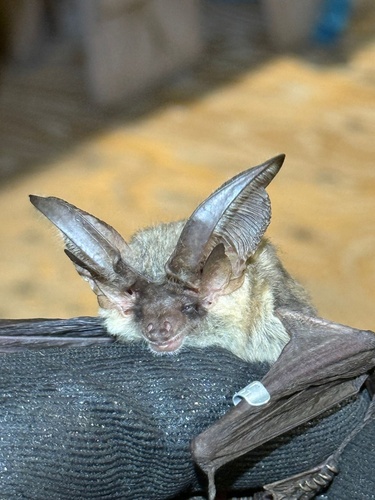
The Gray Long-eared Bat has ears almost as long as its body, which it can fold and hide under its wings while resting, leaving only the pointed tragus visible. This gives it a very distinct profile compared to most European bats. It hunts by whispering: it emits echolocation pulses so soft they are barely detectable at a distance. This strategy allows it to go unnoticed by the extremely sensitive ears of the moths it feeds on, often picking them directly from vegetation. It shares this behaviour almost to the last detail with its closest relative, the Golden Long-eared Bat. In many parts of Europe, it is practically impossible to distinguish the two without holding them in the hand.
The Gray Long-eared Bat is a small-medium sized bat, but unmistakable due to its enormous ears, which are almost as long as its body and joined at the base. When at rest, it folds them under its wings, leaving the tragus visible. Greyish-brown fur. It is only confused with the Northern Long-eared Bat (Plecotus auritus), which also has similarly long ears but slightly browner, warmer fur and a slightly shorter muzzle. Reliable separation between the two often requires examining details of the penis or skull.
Peak energy frequency between 25 and 50 kHz, with a downward sweep. Emits a very low intensity FM pulse. This 'whispering' bat produces a weak, short trace on the detector screen, which is easy to miss if not very close to the animal. Duration of 2 to 5 milliseconds, with poorly defined pulses due to the low emission intensity. Cannot be reliably separated
Open and semi-open areas with hedges, orchards, and scattered trees, sheltering in attics, churches, tree hollows, and building crevices, from lowlands to mid-mountain areas. Distributed across much of Europe, North Africa, and the Near East to Central Asia.
Insectivorous, the Gray Long-eared Bat specialises in moths. It locates them largely by hearing rather than active echolocation, often picking them up directly from vegetation where they are perched.
The Gray Long-eared Bat forms small breeding colonies, often in man-made structures, and is very sensitive to disturbance in its breeding and hibernation roosts. Its slow flight and whispering echolocation allow it to pass close to vegetation without being detected by the moths on which it feeds.
Its populations are in slight decline in much of central and eastern Europe, mainly due to the loss of roosts in old buildings, while in other areas it remains relatively stable.
Restoration and sealing of attics and old buildings, eliminating breeding roosts; insecticide use, reducing moth availability; and loss of hedges and scattered trees in the agricultural landscape.
See all species accounts for bats · Full species index
Mammaling is a free app for logging the mammals you find. You record a sighting in a moment — even if it's just a track — your life list grows, and the record becomes available to scientific and conservation projects.
It runs on your phone with nothing to install. If you like, it adds to your home screen like any other app.
Open Mammaling