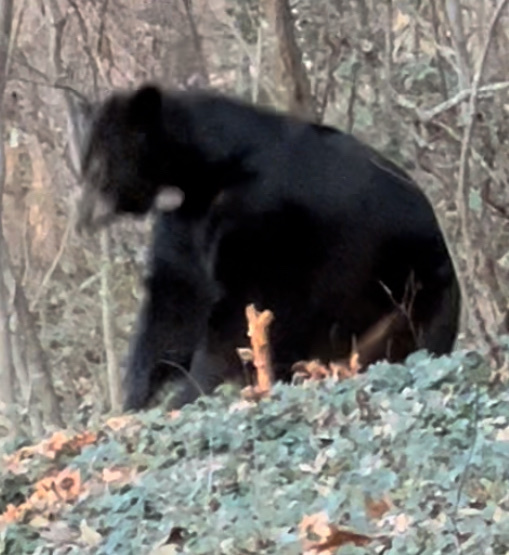
Despite its name, its coat colouring is so variable that in different parts of North America it can be black, cinnamon brown, or even—in a couple of very specific Pacific coast populations—bluish or almost white due to a recessive genetic mutation rarely seen in large carnivores. It is the smallest and most widespread bear in North America, able to live from temperate forest to semi-arid regions. Its diet is so flexible that it thrives both in pristine forest and on the edges of urban areas where it finds human food. Before entering winter torpor, it gains fat so intensively that it can double its body weight in a few months. During this torpor its body temperature drops by only a few degrees—much less than in a true hibernator—allowing it to wake quickly if needed. Females also undergo delayed implantation: they mate in summer, but the fertilised egg does not implant in the uterus until autumn, so that actual embryonic development lasts only a few weeks despite the female remaining pregnant for several months.
A medium-sized bear for the family, with a straight facial profile, an elongated muzzle without the shoulder hump of the Brown Bear, and relatively large, rounded ears. It differs from the Brown Bear in lacking the muscular shoulder hump, having a straighter muzzle, and possessing shorter, more curved front claws better adapted for climbing than digging.
Tracks and signs include 5-toed tracks on both feet. The hind track is 15-20 cm long and almost plantigrade in appearance, resembling a bare human foot. The claw marks are short and very close to the pad, unlike those of the Brown Bear, whose front claws leave a much longer mark further from the pad due to their greater length. Droppings are bulky and variable in shape depending on diet, ranging from cylindrical scats containing seeds and stones to soft, dark masses after feeding on fruit, deposited with no fixed pattern across its home range. It leaves claw and bite marks on tree trunks used as territorial rubbing posts, and in feeding areas it leaves torn-up rotten logs where it has searched for larvae and insects.
Temperate and boreal forest, scrubland and semi-arid mountain areas, from lowlands to medium-high altitudes. Distributed across much of North America, from Alaska and Canada to central Mexico.
Omnivorous, feeding on herbaceous vegetation, fruit, nuts, insects and, occasionally, small vertebrates and carrion, with a diet that varies greatly according to season and local availability.
Solitary outside the breeding season, it enters a partial winter torpor across most of its northern range. During this time its body temperature drops only slightly and it can wake relatively easily. Females exhibit delayed implantation, meaning actual embryonic development is much shorter than the apparent gestation, and give birth during winter torpor itself.
Populations are considered stable or increasing across most of its wide range, with several populations expanding into areas where it had disappeared in the last century.
It faces no significant threats at the species level; locally it suffers regulated legal hunting, roadkill, and conflict with human activity over access to food in peri-urban areas.
See all species accounts for carnivores · Full species index
Mammaling is a free app for logging the mammals you find. You record a sighting in a moment — even if it's just a track — your life list grows, and the record becomes available to scientific and conservation projects.
It runs on your phone with nothing to install. If you like, it adds to your home screen like any other app.
Open Mammaling