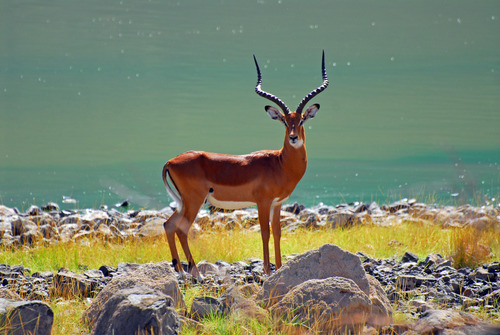
The Impala is probably the antelope most frequently seen in African documentaries without being identified. This elegant, reddish animal can leap more than three metres high and even greater lengths when fleeing a predator, often for no apparent reason other than to confuse. It lives in enormous herds, which serve as a food source for many large African carnivores, an ecological role as discreet as it is essential. Its spiral horns, present only in the male, have inspired the design of a well-known car brand's logo.
The Impala is a medium-sized, slender antelope. Its fur is reddish-cinnamon on the back, lighter on the flanks, and white on the belly. It has vertical black bands on the rump and a black tuft on the metatarsus.
Only the male bears long, lyre-shaped horns.
The black bands on the rump and the black tuft on the hock are diagnostic features, distinguishing it from other reddish antelopes of similar size.
Narrow, pointed, cloven track, 5-6 cm long, with very close-set hooves. Droppings are small, oval pellets, 1-1.3 cm long, deposited in large accumulations (latrines) reused by the entire herd. When fleeing, the Impala can leap more than 3 m long and 2.5 m high, leaving widely spaced landing marks which help differentiate it from other antelopes.
Wooded savanna and scrub with access to water, in transition zones between open woodland and grassland. Widely distributed across East and Southern Africa.
Mixed browser and grazer: it alternates tender grass during the rainy season with leaves and shoots in the dry season, which allows it to occupy a wide variety of habitats.
Gregarious, Impala form herds of females with young and herds of bachelor males. During oestrus, dominant males defend temporary territories and gather harems. Births are concentrated into a few weeks to satiate predators.
Impala maintains very numerous and stable populations across much of its range, favoured by its presence in numerous reserves and hunting estates in East and Southern Africa.
Habitat loss due to agricultural expansion in some peripheral areas. The Black-faced Impala subspecies, isolated in south-western Africa, faces a much more precarious conservation status than the species as a whole.
See all species accounts for even-toed ungulates · Full species index
Mammaling is a free app for logging the mammals you find. You record a sighting in a moment — even if it's just a track — your life list grows, and the record becomes available to scientific and conservation projects.
It runs on your phone with nothing to install. If you like, it adds to your home screen like any other app.
Open Mammaling