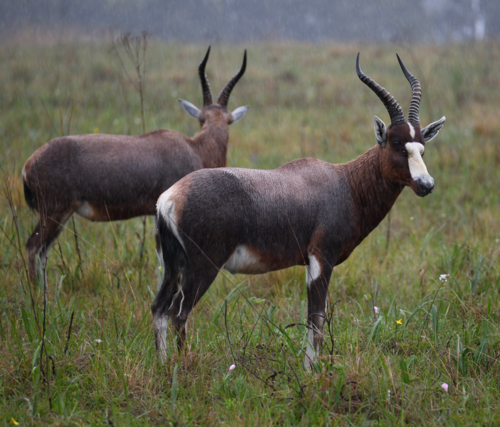
Few antelope species have come so close to disappearing entirely. The Bontebok subspecies was reduced to a handful of individuals in South Africa. Today it survives thanks to protection in reserves, while its relative, the Blesbok, far more numerous, has become a common sight on the South African plains. It is recognised from afar by its striking white blaze on its face, almost as if wearing a painted mask. It is a good example of how two populations of the same species can have completely opposite conservation histories.
Medium-sized, robust antelope with a purple-brown coat and metallic sheen, a white blaze on the face, white legs below the knee, and a white rump. Both sexes have lyre-shaped horns. Confused with the Red Hartebeest, which lacks the white facial blaze and has U-shaped horns.
Cleft track with two pointed hooves, 6-7 cm long. Droppings are oval pellets 1-1.5 cm long, accumulated in dung heaps (middens) reused by males as a territorial mark. This is a typical feature of the alcelaphine group. Territorial males constantly patrol and remark these heaps, visible next to grazing routes.
Open grasslands and coastal short-grass shrubland. The Bontebok subspecies is restricted to a small strip of fynbos in southwestern South Africa, while the much more widespread Blesbok occupies high plateaus of South Africa, Lesotho, and Eswatini.
Grazer specialised in short grasses, actively searching for tender regrowth.
Gregarious: Females and young form herds that move through the territories of adult males. These males defend their territories all year, marking them with piles of droppings. Births are concentrated into a few weeks to saturate predators.
Reduced to fewer than 20 individuals at the beginning of the 20th century, the Bontebok subspecies has recovered thanks to protection in South African reserves and national parks. Its natural range, however, remains minimal. The Blesbok is abundant and is widely bred on South African game farms.
Hybridisation between Bontebok and Blesbok on farms where both subspecies are mixed, resulting in dilution of the Bontebok's genetic identity, and historical loss of fynbos habitat due to agriculture.
See all species accounts for even-toed ungulates · Full species index
Mammaling is a free app for logging the mammals you find. You record a sighting in a moment — even if it's just a track — your life list grows, and the record becomes available to scientific and conservation projects.
It runs on your phone with nothing to install. If you like, it adds to your home screen like any other app.
Open Mammaling