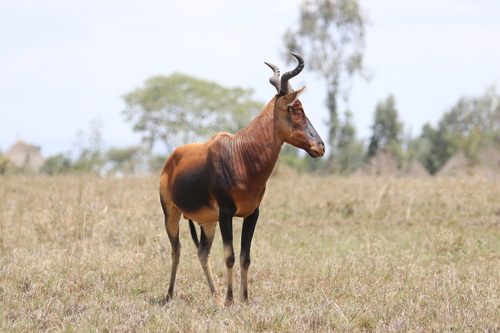
The Hartebeest has an unforgettable silhouette: an elongated, narrow head, horns that vary in shape by subspecies, and forequarters higher than its hindquarters, giving it an ungainly appearance when running.
The Hartebeest is an antelope found in very distinct populations across Africa. Its recent history is varied: some subspecies are extinct, others are in sharp decline, while the southern African subspecies thrives thanks to breeding on private estates.
Few animals so clearly illustrate how unequal the fate of a single species can be depending on its region of birth.
Large antelope with an elongated body, forequarters higher than hindquarters, and a very elongated, narrow head. Both sexes have horns, variable in shape depending on the subspecies, from lyre-shaped to U-ringed. Colour ranges from reddish-brown to yellowish-brown. It can be confused with the Topi or Lichtenstein's Hartebeest where their ranges overlap, but it has a noticeably longer and narrower face than either of them.
Elongated, cloven track, 7-9 cm long, somewhat narrower than a Wildebeest's. Droppings in oval pellets 1.5-2 cm long, scattered or in small piles along grazing routes.
It runs with a characteristic, somewhat clumsy and 'rocking' gallop, due to the height difference between its fore and hindquarters. This is useful for identification at a distance.
Open savanna and medium-tall grassland, from lowlands to high plateaus. The Hartebeest is highly fragmented, with distinct subspecies in southern, eastern, and western Africa. The bubal subspecies from northern Africa is already extinct.
Specialised grazer on grasses, with a preference for medium-height grass that other ungulates leave after grazing.
Hartebeest are gregarious, forming herds. Territorial males defend fixed areas throughout the year. Some East African populations undertake seasonal movements, following the rain and the regrowth of grass.
The situation varies dramatically by subspecies: the Red Hartebeest of southern Africa is abundant and increasing thanks to breeding on game farms, while populations in East and West Africa have suffered sharp declines.
Habitat loss due to agricultural expansion, competition with livestock and intense poaching in East and West African populations, far exceeding the pressure faced by those in the south.
See all species accounts for even-toed ungulates · Full species index
Mammaling is a free app for logging the mammals you find. You record a sighting in a moment — even if it's just a track — your life list grows, and the record becomes available to scientific and conservation projects.
It runs on your phone with nothing to install. If you like, it adds to your home screen like any other app.
Open Mammaling