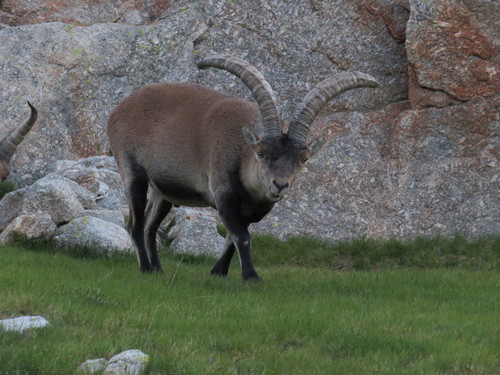
It can move across almost vertical rock faces with a sure-footedness that seems to defy gravity, balancing on ledges just a few centimetres wide thanks to hooves specially adapted for climbing.
Barely a century ago, the Iberian Ibex was on the verge of extinction, reduced to a handful of isolated populations on the Iberian Peninsula. Its subsequent recovery is one of the most successful long-term examples of European wildlife conservation.
Males develop robust, lyre-shaped horns that can exceed one metre in length, and which they use in ritualistic fights, especially intense during the rut.
The Iberian Ibex is a medium-sized animal with a greyish-brown coat, which darkens notably in adult males during the rut. Black markings on the legs and flanks are very pronounced in males and barely visible in females. Males have thick, lyre-shaped horns, curved backwards and outwards, which are much more developed than those of the female. It differs from the feral Domestic Goat by the shape of its horns, and from the Chamois, which has much finer, straight horns hooked at the tip.
Iberian Ibex tracks are similar to a domestic goat's but somewhat narrower and more pointed, 5-7 cm long, with the two hooves very close together and clearly marked even on rock with dust or fine mud. Droppings are in the form of oval pellets, 1-1.5 cm long, grouped in piles on rocky ledges and platforms repeatedly used as resting areas
Rocky and steep mountain areas, from mid-mountain scrub to alpine pasture above the treeline, at altitudes that can exceed 3000 m. Endemic to the Iberian Peninsula, with populations fragmented across several mountain ranges.
Herbivorous, the Iberian Ibex feeds on grass, scrub, leaves and woody shoots depending on seasonal and altitudinal availability. Its diet becomes more woody in winter when herbaceous pasture is scarce.
Iberian Ibex live in sex-segregated groups for most of the year. Females and young form herds, while adult males are more solitary or found in small groups outside the oestrus period. Males compete for access to females through horn-clashing contests, which are especially intense in autumn.
Iberian Ibex populations have recovered remarkably from historical lows in the early 20th century, thanks to legal protection and controlled hunting management. However, occasional outbreaks of sarcoptic mange have caused mass mortalities in some mountain ranges.
Periodic outbreaks of sarcoptic mange that can rapidly decimate entire populations, competition with domestic livestock for grazing in some areas, and habitat fragmentation between mountain ranges limiting genetic exchange.
See all species accounts for even-toed ungulates · Full species index
Mammaling is a free app for logging the mammals you find. You record a sighting in a moment — even if it's just a track — your life list grows, and the record becomes available to scientific and conservation projects.
It runs on your phone with nothing to install. If you like, it adds to your home screen like any other app.
Open Mammaling