The American Bison is the heaviest terrestrial mammal in North America, a large bovid which, barely two centuries ago, formed herds of tens of millions of individuals. These herds alone sustained the economy, diet, and culture of numerous indigenous peoples of the Great Plains. Its near extinction in the late 19th century, when massive commercial hunting reduced it to just a few hundred animals, and its subsequent recovery through breeding programmes on ranches and reserves, is today one of the most cited wildlife conservation stories in North America. Its scientific name is debated among specialists: traditionally, it is placed in the genus Bison, separate from cattle, although recent genetic studies suggest it may be closer to the genus Bos than classical classification indicated.
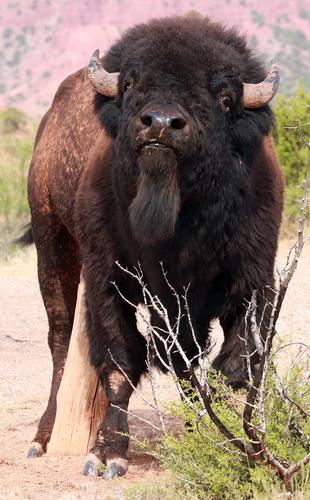
A large bovid, the American Bison is the largest terrestrial mammal in North America. It has a massive body with a pronounced muscular hump over the shoulders. Its large head bears short, upward-curving horns in both sexes. The dark brown fur is longer and woollier on the head and shoulders than on the rest of the body. The American Bison cannot be confused with any other wild mammal in its range, due to its characteristic size and hump.
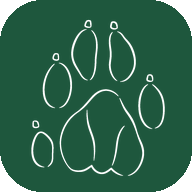
Huella redondeada con dos pezuñas bien separadas, 12-15 cm long, notably larger than that of any comparably sized domestic cattle. Voluminous, flat, cake-shaped droppings, 20-30 cm in diameter, very similar to cattle droppings but larger.
American Bison leave very characteristic scrapes and dust wallows. These are circular depressions up to 2-3 m in diameter in loose soil, where they wallow to rid themselves of parasites. They also leave rubbing marks on trees and posts at shoulder height.
Tall and short-grass prairie, savanna, and transitional open woodland areas, from lowlands to mid-mountain regions. Native to North America, with a historical distribution that covered much of the Great Plains. Today, its range is reduced to reintroduced populations in conservation-managed reserves and ranches in several countries in the region.
Herbivorous, the American Bison feeds mainly on grass, supplemented by woody shoots in winter when herbaceous grass is scarce under the snow.
The American Bison lives in mixed herds of females and young. Adult males are more solitary or form small groups outside the summer oestrus period, when they compete for access to females through horn fights and shoving. Historically, the American Bison undertook large seasonal movements, following the availability of pasture. This behaviour is now greatly restricted by the fencing of most current populations.
Its populations have recovered remarkably from their historic low at the end of the 19th century thanks to breeding on ranches and in reserves. However, the vast majority of American Bison today live in managed and fenced populations, with very few truly wild and ecologically functional herds.
Restriction to small, managed populations, which limits its ecological role as a large migratory herbivore; hybridisation with domestic cattle in the past, which has left genetic introgression in much of current populations; and historical loss of native prairie habitat due to agricultural conversion.
See all species accounts for even-toed ungulates · Full species index
Mammaling is a free app for logging the mammals you find. You record a sighting in a moment — even if it's just a track — your life list grows, and the record becomes available to scientific and conservation projects.
It runs on your phone with nothing to install. If you like, it adds to your home screen like any other app.
Open Mammaling