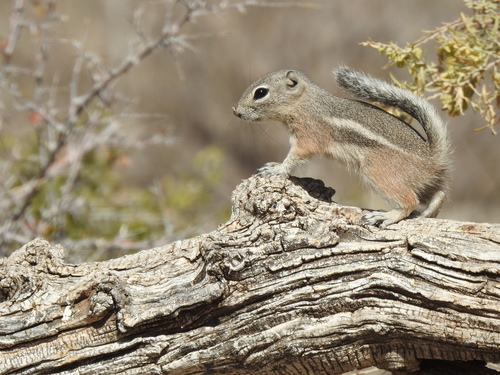
It shares the same general appearance and the same custom of running with the curved tail on the back as the rest of the North American desert antílope slopes, but its distribution area is limited to a much smaller strip of rocky terrain and slopes of the center-south of North America, where it cohabits in part of its range with other related species without barely overlaping in the exact type of substrate that each occupies. It lives on rocky slopes and rocky floors of the desert of Chihuahua, where its motifed fur effectively camouflages it against limestone rock. Like the rest of its genre, it is able to remain active under the direct midday sun in the middle of the summer desert, when most other small mammals remain protected underground.
Small terrestrial shell, gray coat motifed with a white strip on each side of the body, without dorsal strips, and tail that is curved over the thigh when running. It differs from other species of antelope shell of its area mainly by the type of rocky substratum it occupies and by its most restricted distribution to the Chihuahua desert; at first sight it is very difficult to distinguish from its closest relatives without knowing the exact location.
Small footprint with 4 front fingers and 5 rear fingers, 2-2.5 cm rear, similar to that of other antílope slopes and associated almost always with open rocky or rocky terrain. Small and enlarged excrement, 5-7 mm, left scattered across their forage territory. Excavate simple strawberries, often low or between loose rocks, of a single entrance of 4-5 cm in diameter, without the large land mount of other excavating species.
Rocky slopes and slopes of desert and dirt, from low lands to mid-mountain slopes.Distributed by a center-south strip of North America, in the southwest of the United States and the north-centre of Mexico.
Omnivorous, it feeds on seed, cactus fruit and occasional insect, obtaining much of the water it needs from the juicy vegetation of the desert.
Solitary and strictly daytime activity, active even in the hottest hours of the day, not hibernating, andining activity throughout the year except in the periods of cold most intense in the northern end of its distribution.
Its populations are considered stable in most of its area of distribution, without signs of significant decline.
It does not face significant threats at species level; locally suffers punctual loss of habitat due to extractive activity and agricultural expansion.
See all species accounts for rodents · Full species index
Mammaling is a free app for logging the mammals you find. You record a sighting in a moment — even if it's just a track — your life list grows, and the record becomes available to scientific and conservation projects.
It runs on your phone with nothing to install. If you like, it adds to your home screen like any other app.
Open Mammaling