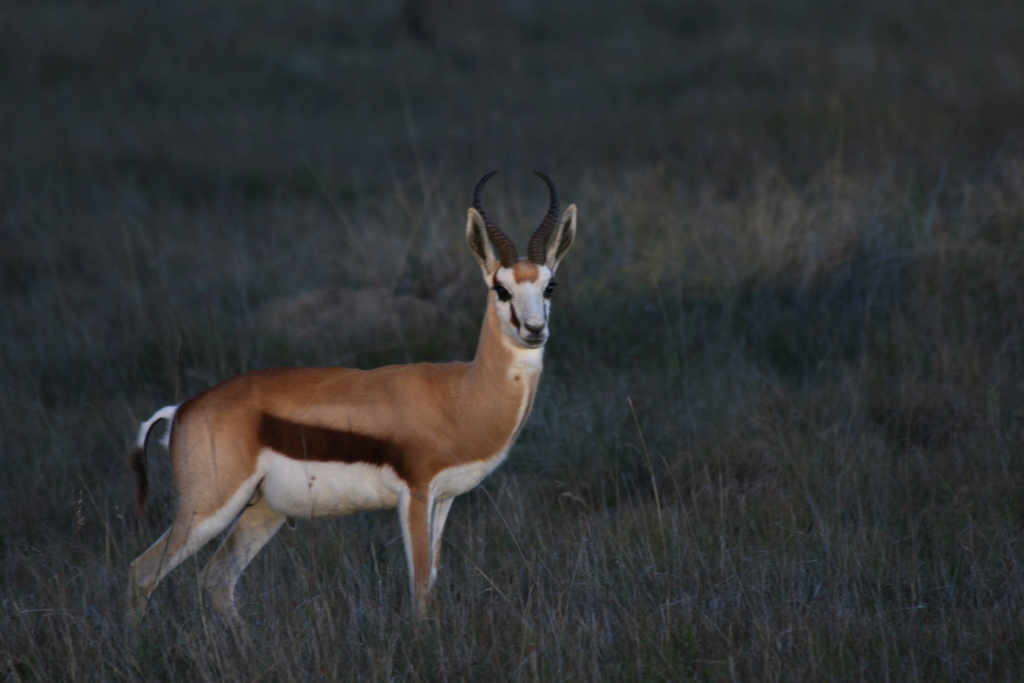
The national animal of South Africa, it owes much of its fame to “pronking”, a strange, stiff vertical leap that ends with an arched back while it fans out a showy crest of white hair along the spine. It once formed migratory herds of more than a million animals that crossed the plains in historic surges, now lost because the land has been fenced.
Medium-sized gazelle, about 75 cm at the withers, with a reddish-brown back separated from the white belly by a very marked dark band, a white face with dark stripes running across the eyes, and lyre-shaped horns present in both sexes, larger in males. It is distinguished from other African antelopes of similar size by this sharp colour contrast and by the erectile white crest that it displays when leaping.
Small, narrow, pointed cloven-hoof track, similar to that of other gazelles. Herds leave well-marked paths between grazing areas and water. The most reliable way to identify it in the field is usually to see the characteristic vertical leap directly, rather than the signs.
Arid and semi-arid grassland, karoo scrub and savannah, mainly in southern Africa (South Africa, Namibia, Botswana).
An intermediate browser-grazer that alternates between grass and shrubs with the season, and can go without drinking for long periods, obtaining water from succulent plants.
Highly gregarious, forming herds of tens to thousands of individuals. Performs the characteristic stiff vertical leap called “pronking” when alarmed or excited.
Stable or increasing population, thanks largely to its breeding on game farms in South Africa and Namibia, although it has disappeared from much of its historical range outside fenced areas and reserves.
Loss of the great historic migrations through fencing of the land, although the species itself is not threatened.
See all species accounts for even-toed ungulates · Full species index
Mammaling is a free app for logging the mammals you find. You record a sighting in a moment — even if it's just a track — your life list grows, and the record becomes available to scientific and conservation projects.
It runs on your phone with nothing to install. If you like, it adds to your home screen like any other app.
Open Mammaling