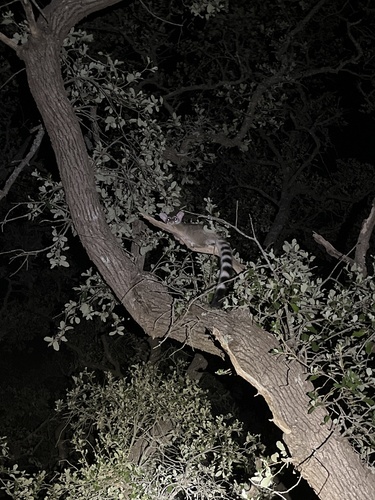
The Ringtail can descend a vertical wall or a tree trunk headfirst, thanks to extraordinarily flexible ankles that can rotate almost 180 degrees. This acrobatic feat, which few mammals of its size can match, allows it to exploit rocky crevices and vertical hollows beyond the reach of most predators. Its long, black-and-white ringed tail, almost as long as the rest of
A small, slender carnivore, it has greyish-brown fur with a pale belly, large eyes surrounded by a dark ring, and a very long, bushy tail with alternating black and white rings. It differs from the very similar Central American Ringtail by living in more arid and rocky areas and by having slightly more distinct tail rings. From other small carnivores in its range, the Ringtail is immediately distinguishable by its long, striking ringed tail.
Tracks show 5 toes on both feet. Hind tracks are 3-4 cm long, with fine, shallow claw marks, and are somewhat smaller and narrower than a Raccoon's. The gait pattern often includes sections of leaping over rocky terrain.
Droppings are elongated and twisted, 4-7 cm long, with visible seed, hair, and insect remains. They are frequently deposited in fixed latrines on elevated rocks or near the den entrance.
The Ringtail's presence is also revealed by dens in rock crevices or tree hollows, often with food remains accumulated near the entrance. Additionally, claw marks from climbing vertical surfaces are a sign, as no other carnivore of its size in the area climbs with the same skill.
Rocky areas, canyons, arid forest and scrubland, from lowlands to mid-mountain elevations. Distributed across western and central North America, from the southwestern United States to southern Mexico.
Omnivorous, the Ringtail feeds on small mammals, birds, insects, and fruit, hunting mainly by ear in the dark.
Solitary and territorial, the Ringtail is strictly nocturnal, sheltering during the day in rock crevices, tree hollows or abandoned human structures. It is an extraordinarily agile climber, capable of descending vertical surfaces thanks to its flexible ankles.
Its populations are considered stable across most of its home range, with no signs of significant decline.
It faces no significant threats at species level; locally it is affected by roadkill and bycatch in traps set for other species.
See all species accounts for carnivores · Full species index
Mammaling is a free app for logging the mammals you find. You record a sighting in a moment — even if it's just a track — your life list grows, and the record becomes available to scientific and conservation projects.
It runs on your phone with nothing to install. If you like, it adds to your home screen like any other app.
Open Mammaling