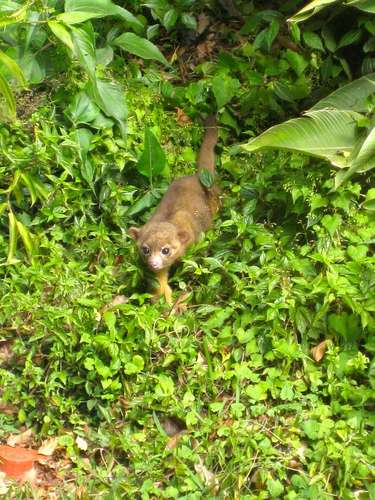
One of the few carnivores in the world with a fully prehensile tail, capable of supporting its own weight hanging from a branch while using all four free feet to reach fruit or insert its extremely long tongue into a flower for nectar. Its appearance, resembling a small primate with large eyes and a rounded face, has earned it the nickname "honey bear" in parts of its range, despite having no relationship to primates: it is actually a close relative of the raccoon. It spends almost its entire life in the tropical rainforest canopy, where its role as a nocturnal pollinator of several tree species and as a seed disperser is key to forest regeneration. Strictly nocturnal, it sleeps during the day in tree hollows, often shared by several individuals from the same social group.
A medium-sized arboreal carnivore with short, dense, uniform golden-brown fur, large eyes that reflect at night, and a long, unringed prehensile tail. It differs from the Cacomistle and other arboreal procyonids in its range by lacking rings on its tail and by its rounded face without the dark mask typical of those relatives, and from any nocturnal primate by its prehensile tail, which is absent in all American primates.
Tracks and signs: tracks with 5 toes on each foot, the hind track with a slightly separated thumb, 3-4 cm long, rarely visible as it travels almost exclusively through the canopy without touching the ground. Elongated droppings 4-6 cm long containing abundant visible fruit seeds, frequently deposited in the same latrines used repeatedly by several individuals beneath regular feeding trees. Its presence is also revealed by tooth and claw marks on the bark of flowering or fruiting trees, and by half-eaten fruit fallen beneath canopy trees where it has fed.
Humid tropical rainforest canopy, from lowlands to mid-mountain elevations. Distributed from central Mexico to southern Brazil, throughout Central America and much of tropical South America.
Mainly frugivorous, it feeds on ripe fruit and nectar, supplemented with tender leaves, small invertebrates and, occasionally, eggs.
Strictly nocturnal, it lives in small social groups that share tree hollows for sleeping during the day, maintaining social bonds that include mutual grooming—unusual among carnivores. It moves almost exclusively through the canopy, rarely coming down to the ground.
Its populations are generally considered stable across most of its wide distribution range, although it suffers local declines due to the loss of mature forest with large trees.
Deforestation and rainforest fragmentation, alongside occasional capture for the pet trade in parts of its range.
See all species accounts for carnivores · Full species index
Mammaling is a free app for logging the mammals you find. You record a sighting in a moment — even if it's just a track — your life list grows, and the record becomes available to scientific and conservation projects.
It runs on your phone with nothing to install. If you like, it adds to your home screen like any other app.
Open Mammaling