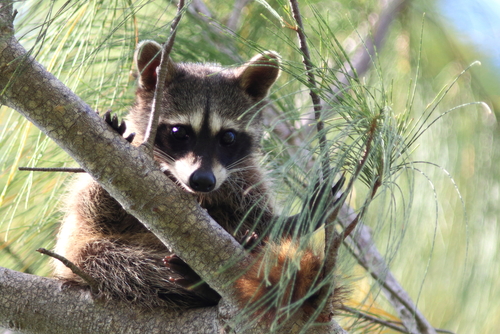
It is the smallest mapache in the world, barely half the size of its continental relatives, a classic case of insular nanism that has evolved on the island of Cozumel after generations of complete isolation from the rest of American mapaches. It lives exclusively in the mangroves and the low jungle of this Mexican Caribbean island, where it seeks crab, fruit and insect between mangrove roots and soil leaf. It is one of the world's most threatened insular carnivores, with a total population heading within the limits of a single small island, something that makes it extraordinarily vulnerable to any catastrophic event such as a hurricane or the arrival of a disease.
Mapache small, notably smaller than the continental common mapache, with the characteristic dark antifas around the eyes and the tail ringed in white and black, but of more graceful complexion and shorter legs in proportion to the body.
Fingerprint with 5 front fingers and almost human-looking rear fingers, smaller than that of the continental mapache, 4-5 cm the front. Cylindrical and dark excrete, 5-7 cm, with remains of crab, fruit and insect visible, left in communal letrinas near manglar feeding areas. Leaves marks of clutches on trunks when climbing and remains of crab shell departed next to charcas and manglar areas where it feeds.
Manglar and rainforest low tropical, in lowlands of the island of Cozumel. Endemic of this island of the Mexican Caribbean, opposite the coast of Quintana Roo, without natural presence outside it.
Omnivorous, it feeds on crabs, fruits, insects and small vertebrates from the manglar and the low forest of the island.
Solitary and mainly nocturnal activity, with a campground territory centered on the island's manglar and low forest areas.
Its population is estimated at a few hundred individuals, with a decline trend associated with the loss of habitat by tourist development and road mortality; intense hurricanes pose an added risk given the reduced total population.
Tourist and urban development that fragments the island's manglar and low forest, road crashes, and intense hurricanes that can cause massive mortality given the reduced total population of the species.
See all species accounts for carnivores · Full species index
Mammaling is a free app for logging the mammals you find. You record a sighting in a moment — even if it's just a track — your life list grows, and the record becomes available to scientific and conservation projects.
It runs on your phone with nothing to install. If you like, it adds to your home screen like any other app.
Open Mammaling