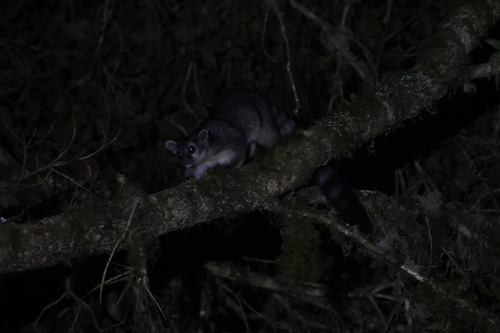
It is the tropical relative of the American cacomixtle, adapted to life in the wet rainforest dosel rather than to the rocky and arid areas that occupy its relative more north, with an even longer tail in proportion to the body it uses as a counterweight when moving through fine branches at great height. It lives in the tropical wet rainforest and Nebula forest of Mesoamérica, where it spends almost all its life in trees and rarely descends to the ground, something unusual among the carnivores of its family. It is a hunter and night-foregiver of very varied diet, which combines the hunting of small vertebrates with the consumption of fruit and insect according to the seasonal availability of the forest.
Small and thin carnivore, gray to red brown fur, large eyes, and a very long tail with little marked rings compared to the American cacomixtle. It differs from the latter by its tail with more diffuse rings, its strictly arboricular habits and by occupying wet jungle instead of rocky and arid areas; at a distance it can be confused with a civeta or a small night monkey by its thin silhouette and long tail.
Fingerprint with 5 fingers on both legs, the rear of 3-4 cm, rarely visible when moving almost always by the dozel without touching the ground. Extended and twisted excrete, 4-7 cm, with seed and visible insect, deposited in branches or tree holes used as regular passing points. Its presence is mostly delated by fruit remains in high branches and by tree holes used as daytime shelter with garlic marks at the entrance.
Tropical rainforest and fog forest, from low lands to mid-high mountain heights.Distributed by Mesoamerica, from the center of Mexico to Panama.
Omnivorous, it feeds on fruit, small vertebrates, insects and eggs, foraging almost entirely in the forest dosel.
Solitary and of strictly arboric habits, of night activity, rarely descends to the ground.It refuses during the day in high tree holes, and its reproductive behavior remains little documented given its evasive nature.
Its populations are generally considered stable in most of its Mesoamerican distribution area, although locally it is sensitive to the loss of mature forest with large trees.
Deforestation and fragmentation of wet rainforest by agricultural and livestock expansion in Mesoamerica.
See all species accounts for carnivores · Full species index
Mammaling is a free app for logging the mammals you find. You record a sighting in a moment — even if it's just a track — your life list grows, and the record becomes available to scientific and conservation projects.
It runs on your phone with nothing to install. If you like, it adds to your home screen like any other app.
Open Mammaling