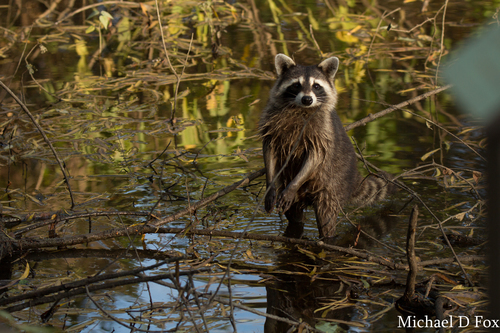
His free front legs, with long and extraordinarily sensitive fingers, work almost like hands: he is able to open closures, turn apples and manipulate objects with a skill that few mammals match, a skill that has allowed him to successfully colonize from forests to the garbage containers of the big cities. The behavior of "washing" the food in water that he is so attributed is not actually cleaning, but a way to moisturize the legs to intensify the touch information that his sensitive pillows receive, something that he also does with dry food away from any source of water. His black antifaze around the eyes and his ringed tail make him one of the most recognizable silhouettes of the American nightlife, and his enormous adaptability has allowed his urban populations to reach densities very higher than the wild
A medium-sized carnivore, gray coat with black antifas around the eyes bordered with white, and thick tail with 5-7 alternate dark rings. It differs from any other mammal in its area by that combination of antifas and ringed tail, a pattern that does not share any other native carnivore in the region.
Fingerprint with 5 long and very separate fingers on both legs, the rear of 6-8 cm and almost human appearance for its lengthy shape, very different from the compact four-fingerprint of a dog or fox. Cylindrical and rom extremes, 5-8 cm, with seed and visible bone, often deposited in communal letrinas at the base of trees or on fallen trunks. Leaves traces of garlic when climbing, remains of river crab or molluscs with the shell split next to water, and garbage containers rolled or opened in urban areas, an increasingly common sign of their presence.
Very varied, from river forest to wetlands, meadows and urban and periurban areas, from low lands to mid-mountains.Native to much of North America and Central America, and introduced and established as an invasive species in various regions of Europe, Asia and the Caucasus.
Opportunist omnivore, it feeds on fruit, water and terrestrial invertebrates, small vertebrates, eggs and, in urban areas, garbage and remains of human food.
Solitary outside the breeding season, of night activity, remains inactive in periods of intense cold in protected shelters without really hibernating.It is a skilled treader that uses tree holes or human structures as a shelter, and its great plasticity of behavior allows it to exploit very varied resources according to the environment.
Its native populations are considered stable or increasing in virtually all of its area of distribution, while populations introduced in Europe and Asia continue to expand and are subject to control programs for their impact on local fauna.
In its native area it does not face significant threats at species level; it is a frequent carrier of rabies and an intestinal parasite that can affect other species, which motivates its control in some areas.
See all species accounts for carnivores · Full species index
Mammaling is a free app for logging the mammals you find. You record a sighting in a moment — even if it's just a track — your life list grows, and the record becomes available to scientific and conservation projects.
It runs on your phone with nothing to install. If you like, it adds to your home screen like any other app.
Open Mammaling