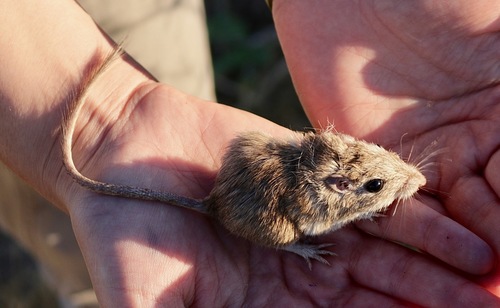
He is a small rodent from the arid areas of the Lower California Peninsula, able to complete his entire life cycle without drinking a single drop of liquid water, obtaining all he needs from the metabolism of the dry seeds that form the basis of his diet. Like the rest of bacon mice, he carries food collected in external hair-coated bags located on both sides of his mouth, which he can empty by turning them out to discharge food in the nursery. He lives in coastal dunes and sandy desert of Lower California and several islands of the Gulf of California, where several island populations have developed notable size and colour differences with regard to continental populations, a common pattern among small mammals from the Gulf Islands.
Small rodent, very pale sandy brown coat that serves as camouflage on the sandy substrate where he lives, body covered with rigid hair mixed with thin spines, and long tail with terminal moss. It differs from other mice of bacon in its area by its especially pale colour, adapted to the clear sandy substrate of the coastal dunes it occupies.
Small footprint with lengthy rear legs, 1.5-2 cm, with coupled jump marks typical of desert biped rodents. Small, lengthy feces, 4-6 mm, left dispersed near the strawberry. Excavate simple strawberries in loose sandy soil, with the entrance often covered with sand during the day to preserve indoor moisture.
Coastal dunes and sandy desert, from sea level to low quotas.Distributed by the Baja California peninsula and several islands of the Gulf of California, Mexico.
Granivorous, it feeds mainly on seeds, complemented with juicy vegetation and occasional insect, without the need to drink liquid water.
Solitary and territorial, of strictly nocturnal activity, it remains in its nursery during the hours of daytime heat.The insular populations often show size differences with respect to the continental, a regular pattern among small mammals from the islands of the Gulf of California.
Its populations are considered stable in most of its area of distribution.
It does not face significant threats at species level; locally suffers habitat loss due to tourist and coastal urban development.
See all species accounts for rodents · Full species index
Mammaling is a free app for logging the mammals you find. You record a sighting in a moment — even if it's just a track — your life list grows, and the record becomes available to scientific and conservation projects.
It runs on your phone with nothing to install. If you like, it adds to your home screen like any other app.
Open Mammaling